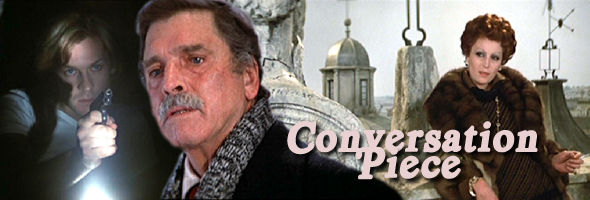
Color, 1974, 121m.
Directed by Luchino Visconti
Starring Burt Lancaster, Helmut Berger, Silvana Mangano, Stefano Patrizi, Claudia Marsani
Raro (Blu-Ray & DVD) (US R0 HD/NTSC), Arrow (UK R0 PAL), Madman (Australia R4 PAL) / WS (2.35:1) (16:9)
Color, 1974, 121m.
Directed by Luchino Visconti
Starring Burt Lancaster, Helmut Berger, Silvana Mangano, Stefano Patrizi, Claudia Marsani
Raro (Blu-Ray & DVD) (US R0 HD/NTSC), Arrow (UK R0 PAL), Madman (Australia R4 PAL) / WS (2.35:1) (16:9)
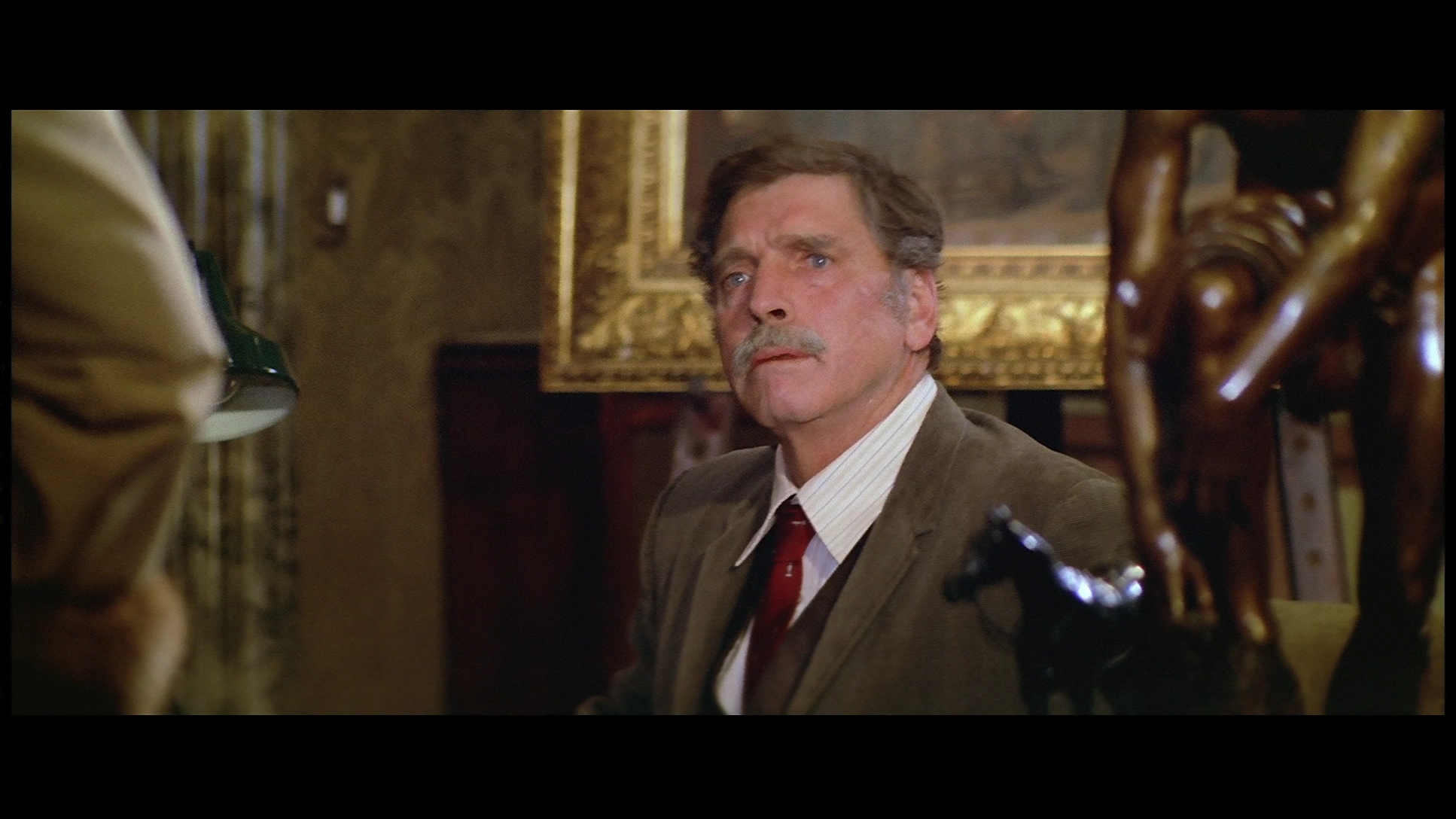 Emphasis on the word "conversation" in the title here, as director Visconti explores his twilight years with a drawing room black comedy after the orgiastic excess of Ludwig. For the last time he composes a tragic ode to his muse, Helmut Berger, with whom he shared a more than slightly complicated relationship off-camera; in many respects this could represent the director coming to terms with society and the film world advancing on without him, reflected in the central character of the Professor (Lancaster) who just wants to be left alone with his books and art relics.
The Professor owns an aging house in Italy with an expansive 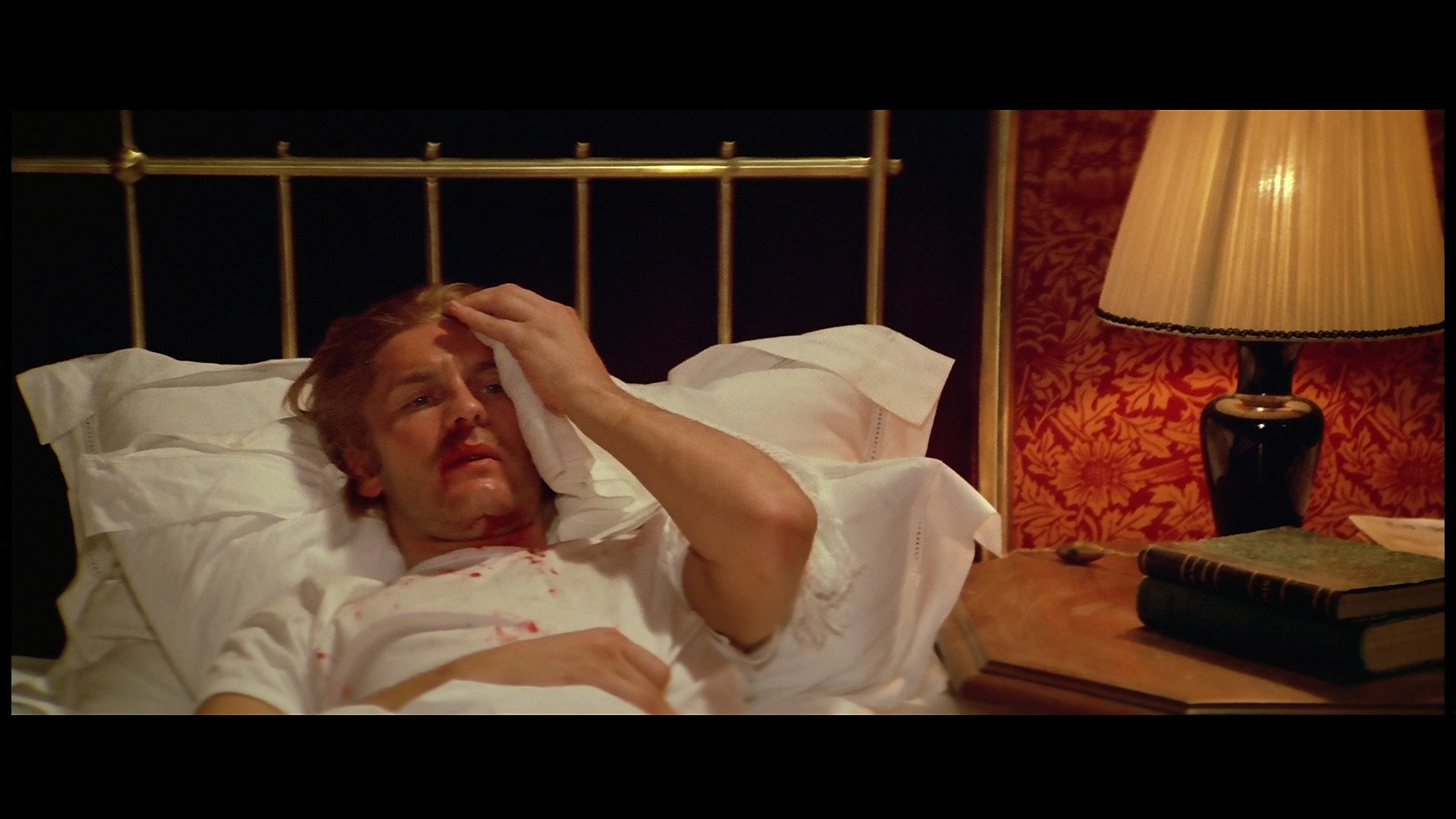 upper floor he plans on converting into a library; unfortunately his world is torn asunder with the arrival of a pushy, bourgeois Marchesa, Bianca (Pasolini goddess Silvana Mangano), who insists on leasing out the floor for one year as an apartment. However, the rental turns out to be for her pouting kept boy, Konrad (Berger), though it's occupied just as often by her daughter, Lietta (Claudia Marsani) and her milquetoast boyfriend, Stefano (Stefano Patrizi). Much to the Professor's irritation, the family bustles in and out, makes unauthorized alterations to the apartment (complete with water leaks and knocked-down walls), and generally makes a nuisance of itself. However, after nasty start, the Professor and Konrad reach a tentative understanding when the latter is attacked and left bloody in the middle of the night. Unfortunately the Professor soon realizes that life has passed him by, leaving some rich, spoiled brats to take over the world.
Though filmed with his usual immaculate eye for décor and composition, the first half of Conversation Piece (Gruppo di famiglia in un interno) is unusually spry and funny for a Visconti film. Lancaster's flustered reactions and Berger's profane telephone threats make for great trash viewing, and the story really kicks into gear one hour in with a kinky plot twist that really could have been developed even furth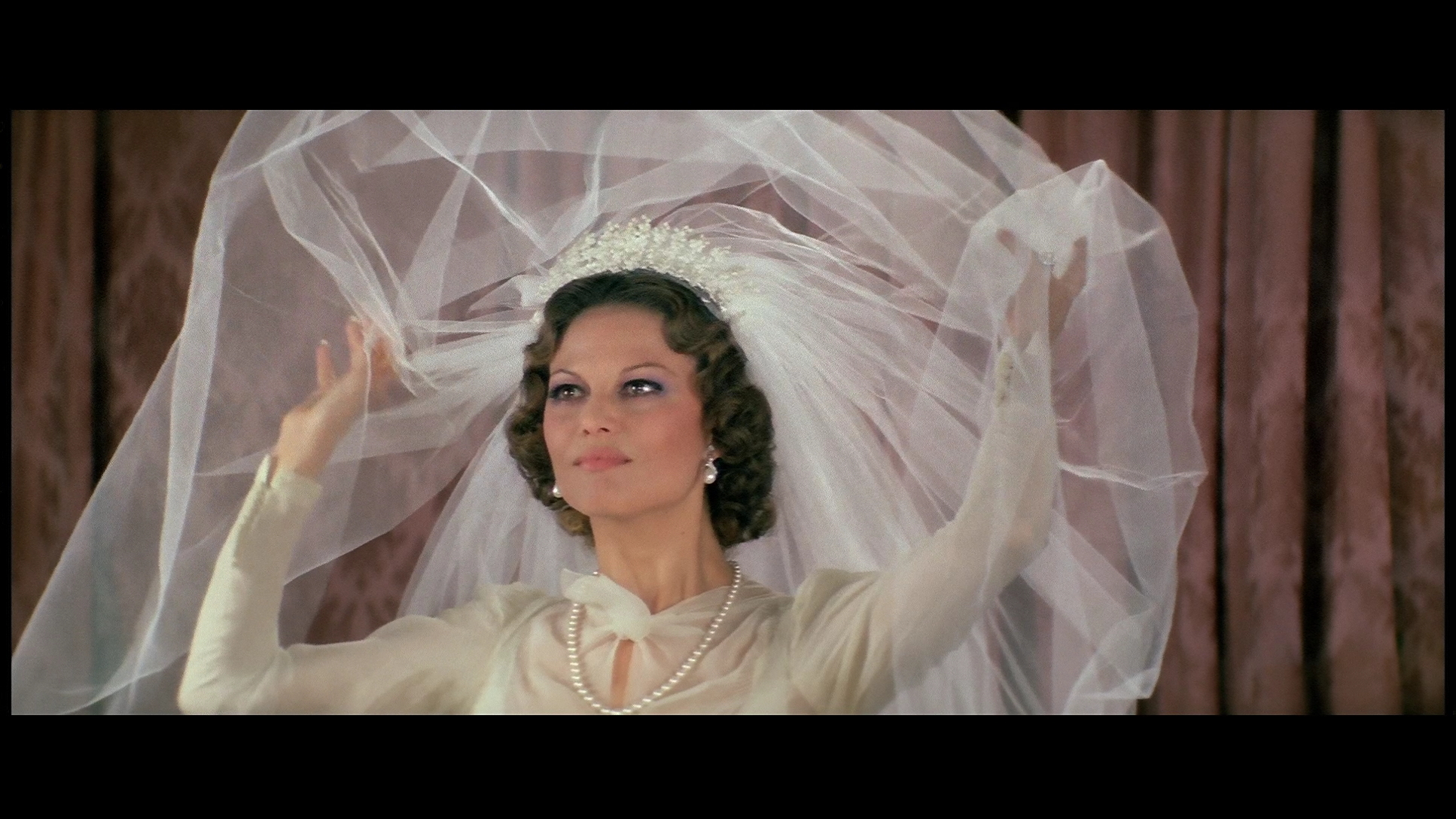 er. After this high point, the film heads into more straightforward dramatic (and socially-charged) territory on its way to a tragic climax; devotees of melodrama will no doubt enjoy the climactic dinner party, which finds everyone screaming at the top of their lungs about politics and Berger eventually shunned because, apparently, he leans a little to the left. The last few minutes are pretty standard Visconti in his Death in Venice mode, with characters wistful about the tragedy of their lives, though it's a marked change from the amusing unpredictability of the rest of the film..
Of course, when a movie looks this gorgeous, its flaws barely even register. The scope framing is never less than stunning, often turning confined spaces into elaborate visual vistas worthy of a David Lean epic. The performers and settings alike are never less than ravishing, and the ear candy musical score nicely balances classical music with a couple of dollops of sublime '70s Italo-pop that'll have more than a few viewers scrambling for YouTube..
Pan and scan video transfers of this film are completely unwatchable but were pretty much all anyone had during the VHS era, but the first relief in the digital era came wtih the British DVD from Arrow. The film was shot in English (with Marsani and Patrizi later looped by other actors), though it was screened in both English and Italian versions at festivals (and, according to Raro's liner notes in their own later edition, some American theaters). For some reason Arrow's cover art devotes most of its space to a shot of Dominique Sanda, who pops up for a few seconds in a flashback as the Professor's mother; likewise, look fast for a cameo by Claudia Cardinale in another flashback as his wife. That same transfer was later used for a DVD release in Australia as well.
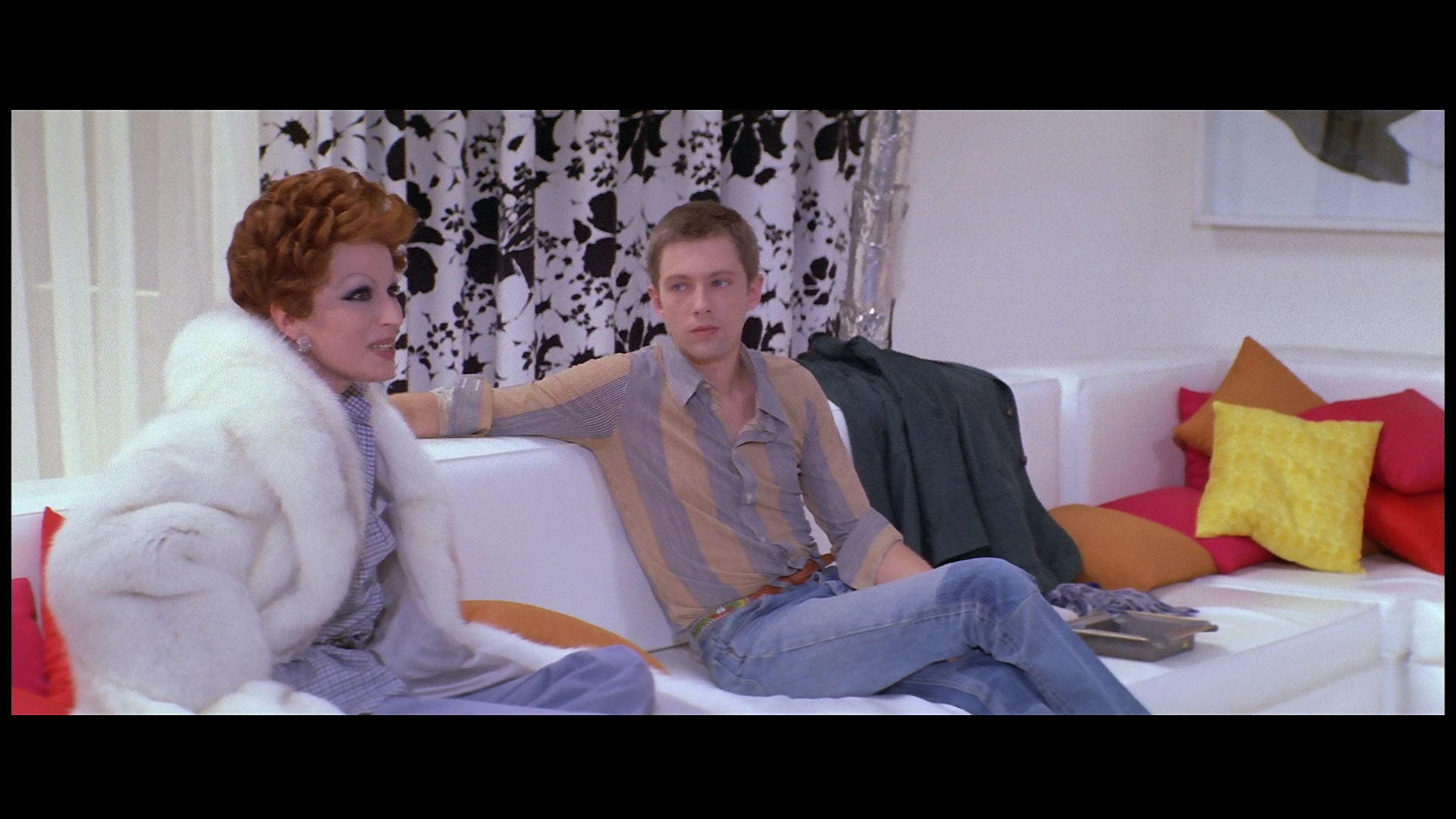 The remastered version released in 2012 by Raro first appeared on DVD, sporting an attractive scope presentation from the Italian negative, clocking in at 121 minutes. (It was originally shown in Italy with an intermission, which may account for initial press listings of a 125-minute running time.) Their DVD also contains only the English track but adds a few welcome new extras: the original Italian trailer (which commences with some unusual artwork of the cast before the usual collection of clips), an interesting video interview with film writer Alessandro Bencivenni who mainly focuses on the context of the film within Visconti's life at the time, and perhaps best of all, very well-researched liner notes by Mark Reynolds, who covers the film's hostile critical reception in American upon its initial release and its odd release history.
Shortly following the DVD, Raro followed it up with a Blu-Ray release containing another reason to upgrade: the Italian language track with optional English subtitles (correctly translated here from Italian, not dubtitles), along with the usual English-language version. Exactly which one is preferable is a tough call; Lancaster's voice is definitely a major asset to his performance, and as with The Leopard, it's a little odd watching it without his familiar intonations. On the other hand, Berger fares much better on the Italian track; the voice performance for his character is much less whiny and bratty, giving him a more complex and charismatic quality that serves the film well. The Italian track also features much more witty versions of Berger's foul-mouthed insults, and the political content comes across a bit more intelligently here than the somewhat awkward English delivery. In essence, both are really worth a viewing, but newcomers may be better off watching it in Italian first. The transfer also looks much more impressive on the Blu-Ray, with reds in particular becoming more vivid and accurately defined; the inventive juxtapositions here of bright decor and lavish, antique architecture makes for a truly rich viewing experience. However, the boost in quality also reveals some evidence of that Italian HD bugaboo that's been popping up with odd regularity lately, a soft and sometimes splotchy texture on close examination. It's more prevalent in some scenes than others; the ones in Lancaster's dwelling generally look crisp and feature some natural-looking grain, but when coupled with what are most likely already soft-filtered close ups (mainly Mangano and that pivotal dark apartment scene at the one-hour mark), it can tend to look mushy. It's still the best version we've had of this film by a wide margin and the first rendition that truly looks like a prime Visconti achievement, but this inconsistency is definitely worth noting. On the audio end, both tracks sound excellent, with the music coming through much more clearly here than before in the background of several scenes. While the Blu-Ray sleeve once again uses that Sanda image, it's also worth noting that the cardboard O-card over it features much more suitable and eye-catching poster artwork of the main characters. A fascinating, beautiful, and oddly wonderful little film that gets better with each viewing.
Colour, 1969, 157m. / Directed by Luchino Visconti / Starring Dirk Bogarde, Helmut Berger / Warner (US R1 NTSC) / WS (1.85:1) (16:9), Istituto Luce (Italy R2 PAL) / DD5.1
Highly controversial at the time of its release, The Damned (also known under the more Wagnerian title of Götterdämmerung and in Italy as La caduta degli dei, or "Fall of the Gods") had a resounding influence on
Perhaps the most shocking thing about the film is its stylistic break with Visconti's earlier films, as the painterly scope compositions of his '60s work are tossed aside in favor of dark, chiaroscuro images often accented with dazzling, colorful lighting straight out of Blood and Black Lace. The shift is further emphasized by Maurice Jarre's brassy, experimental score, which alternates between chilling bombast and sad romanticism. The international cast fares as well as it can given the film's odd production (shot in English but with many performers looped); while Berger (in the first of many roles for partner Visconti) gets most of the showy moments, Bogarde as usual steals the show and proved so powerful he and the director later reteamed for the unorthodox "star vehicle" Death in Venice. Also notable are juicy supporting roles for a young Charlotte Rampling (fresh off a run of English comedies) and future Eurocult starlet Florind
Released in the U.S. with an X rating, The Damned was trimmed down in many territories from 157 minutes to 150 (and even 144 at one point); contrary to popular belief, most of the cuts were made to speed up the narrative rather than tone down the sex and violence. The character of Sophie benefits most from the longest cut of the film, which is retained for the first time in the U.S. on Warner's DVD. The disc's video transfer is composed at 1.85:1, as the film was usually shown in theaters, and overall looks surprisingly good. Colors are rich and vibrant, and flesh tones look accurate throughout. The mono audio is adequate, though many actors (apart from the English-speaking leads) are dubbed with canned, tinny-sounding voices that often sound completely disconnected from the film. Even for ears accustomed to Italian horror films, it's a distracting, amateurish sound mix. That said, Warner's mono disc sounds fine if a little pallid whenever Jarre's score kicks in.
Prior to the Warner disc, the only other option was an Italian release containing the Italian language version with optional English subtitles. Though it never matches anyone's lip movements, this mix is generally easier on the ears and gives the film a classy ambience missing from the English version. The disc contains the mono version as well as a 5.1 remix, which sounds great music-wise but tosses in phony directional effects a little too often. The Italian DVD features a completely open matte transfer, exposing even more information than seen on the less severely matted British tape (which was somewhere around 1.55:1). The open matte version gives the film some much-needed breathing room in several shots, but the 1.85:1 version is workable as well; it will primarily be a matter of individual viewer preferece. Though colors are extremely strong, the Italian transfer suffers from muddy blacks, occasionally soft detail, and yellow flesh tones.
As for extras, the Warner disc includes the U.S. theatrical trailer (with a great tagline retained on the poster art and DVD packaging) and a vintage 9-minute featurette, "Visconti," which shows the director at work with the cast during the making of the film. Though not as interesting as the featurette on Warner's Death in Venice DVD, it's a nice bonus nonetheless. The Italian disc only features an interview with cinematographer Armando Nannuzzi (no subtitles) and a few text supplements. For a comparison between the two discs, click here.
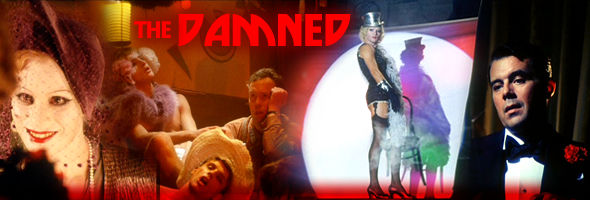
Before The Damned, director Luchino Visconti was primarily known for his sprawling melodramas like The Leopard and Rocco and His Brothers, films which combined Italian neorealist traditions with his own elegant style. During its opening act, this film seems to be business as usual for Visconti as the wealthy Von Essenbeck family dines and carouses in
 their lavish home on the eve of the Third Reich's rise to power. The family patriarch, steel magnate Joachim (Albrecht Schoenhals), is stepping aside and having over responsibility to his associate, Frederick (Bogarde), a sexually confused, fledgling fascist having an affair with one of the Von Essenbecks, Sophie (Ingrid Thulin). Meanwhile Sophie's depraved son, Martin (Berger), performs a drag routine as Marlene Dietrich for the family and seems to sleep with everyone in sight, not excluding members of his own family. Tension rises between Frederick and Martin as they jostle for control of the family and for more favored positions within the Nazi Party, which is gradually eradicating any sense of democracy in Germany and building to the infamous Night of the Long Knives, a massacre that decimated the predominantly gay members of the rival SA party.
 European cinema for the following decade, both good and bad. Italy churned out a series of films dealing with Naziism ranging from the sublime (The Garden of the Finzi-Continis) to the dubious (The Night Porter) to the flat-out deranged (Salon Kitty), but Visconti's film continues to exert a peculiar fascination all its own. The much-touted sex and violence is very mild by today's standards, confined mainly to a few bare bottoms and some stage blood, but the Long Knives sequence is still harrowing due to the cold, clinical precision of its execution rather than explicit shock value.
 a Bolkan.
