The Philippines aren't exactly known for their booming horror film industry, but for a brief period through the 1960s (and, to a small extent, 1970s), producer Eddie Romero made a tidy profit in America's drive-ins by shooting exotic low budget gore epics in the politically charged country and releasing them under campy titles guaranteed to have parents dragging their kids to church services for penance. Romero's career got off to a roaring start with Terror Is a Man, later a hit in drive-ins under the title Blood Creature, and he continued the string of creature features with the infamous Mad Doctor of Blood Island, The Twilight People, and the surreal Brides of Blood. Unfortunately, as the quantities of gore and skin increased, the films suffered overall; in this case, the first was by far the best.
Almost everyone familiar with Terror Is a Man has noted its extreme similarity to H.G. Wells' Island of Dr. Moreau (or more likely, its first film adaptation, Island of Lost Souls). Poor William Fitzgerald (Derr) finds himself on the island of Dr. Charles Girard (Lederer) and his wife, Frances (Thyssen). The opening credits warn that a warning bell (actually the sound of a telephone) will sound and alert the audience of a particularly horrifying sequence, which basically consists of a few seconds of Lederer slicing along a patch of skin with a scalpel. Pretty nasty for 1959, but the face-grafting in the same year's Eyes without a Face leaves it in the dust. Generally this is much better than your average drive-in beastie fare and deserves the attention it has garnered from dedicated late night TV viewers. The beginning is a bit talky, but once things get in gear, this is a lot of fun. Fortunately, Image's newly transferred DVD is a revelation (and nifty cover art, too); the years of scratchy public domain prints and dupey TV screenings completely failed to capture the moody noirish photography and the richly textured jungle scenery. The fact that elements so clean and sharp could still exist for this film is frankly astonishing, though if someone ever manages to dig up a complete print of Mad Doctor of Blood Island that looks this good, the apocalypse must be coming.
B&W, 1959, 89 mins. / Directed by Gerardo de Leon / Starring Francis Lederer, Greta Thyssen, Richard Derr, Oscar Keesee, Jr., Lilio Duran / Image (US R1 NTSC)
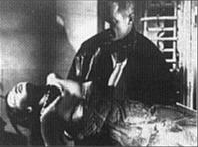 It seems the doctor is convinced he can develop human beings through the genetic components of animals - and of course, he's trying it out on a leopard, with disastrous results. The leopard creature (basically a bandaged man with pointy ears) is quite a sight - not one of the screen's greatest monsters, but definitely one of the oddest.
