Color, 1971, 96 mins. 53 secs.
Directed by Aldo Lado
Starring Jean Sorel, Ingrid Thulin, Mario Adorf, Barbara Bach
Celluloid Dreams (UHD & Blu-ray) (US R0 4K/HD), 88 Films (UHD, Blu-ray & DVD) (UK R0/RB/R2 4K/HD/PAL), Twilight Time (Blu-ray) (US RA HD), Camera Obscura (Blu-ray & DVD) (Austria RB/R2 HD/PAL), Anchor Bay / Blue Underground (DVD) (US R1 NTSC), Neo Publishing (DVD) (France R2 PAL) / WS (2.35:1) (16:9), Koch (DVD) (Germany R2 PAL) / WS (1.78:1) (16:9)
In 1955, the TV 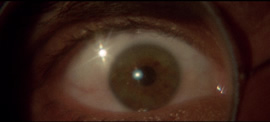 series Alfred Hitchcock Presents traumatized more than a few impressionable viewers with an episode called "Breakdown," in which businessman Joseph Cotten is paralyzed in a car wreck and left in a state closely resembling death. For the fo
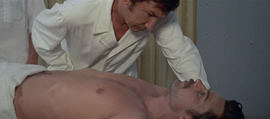 llowing half hour, we follow the poor sap as he's carted off to the morgue and onto the autopsy table, with the requisite twist ending. Demonstrating he could one-up the master of suspense, first time director Aldo Lado ran with the same concept as the basis for a twist-packed giallo in which the protagonist's state of near-death allows the film to flash back and forth in time, gradually revealing details which explain how he came to be in such an uncomfortable predicament. A speeding ambulance rushes the body of reporter Gregory Moore (the underrated Sorel) to a Prague hospital where he's pronounced dead and plopped onto a steel table. Unfortunately, as his voice over indicates, he's still very much alive and aware of his surroundings. In flashbacks we see his tender relationship with beautiful Mira (Bach), who disappears mysteriously one night, and his efforts to investigate with the aid of two colleagues, Jack (Adorf) and Jessica (Thulin). Gradually he uncovers a sinister sect (reminiscent of the one in All the Colors of the Dark) that steers the film into territory somewhere between a conspiracy thriller and an occult shocker.
With its razor-sharp scope photography, methodical plotting, and icy Ennio Morricone score, this unheralded thriller is the sort of treat die-hard Eurocult excavators enjoy discovering. 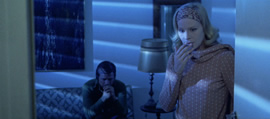 Pushing the definition of a giallo to the edge, it relies more on the viewer's imagination to fill in the grisly gaps in the story without ladling out much in the way of explicit sex and gore. Lado also deserves points for some fairly ruthless viewer manipulation, with a memorable climax guaranteed to elicit a gasp. Sorel, who also appeared in the excellent,
 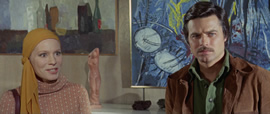 remarkably similar (and excellent) The Double the same year, once again makes a solid leading man and carries the film through more than a few potentially confusing story hurdles, and the rest of the cast all fares well enough. The colorful Adorf, who lent colorful support to more than his share of crime thrillers, offers a robust turn nicely balanced by the more austere Thulin (a Visconti regular). Bach (later Mrs. Ringo Starr) doesn't have much to do, but her presence was effectively used to promote this film on video after her fairly successful acting career through the early '80s.
This co-production between Italy, West Germany, and Yugoslavia had a decent amount of exposure in Europe but never played American theaters, instead making its US debut on VHS in the '80s from MPI in a horrendously cropped edition under the title Paralyzed (complete with an unrelated glamour shot of top-billed Bach on the back of the sleeve). The widest letterboxed version in the VHS era in Europe barely measured to 1.90:1, so it wasn't until Anchor Bay's 2002 DVD that the full scope compositions could finally be appreciated at home. The blue and gray color schemes look accurate throughout, and the mostly dubbed English audio sounds fine. Lado appears on a solid featurette, the 11-minute "Strange Days of the Short Night," in which he explains the completely irrational title; originally the film was going to be called Malastrana and then Short Night of the Butterflies, but commercial considerations from a competing project forced a 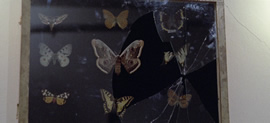 last minute switch. The disc
  also includes a theatrical trailer and Lado bio/filmography, and it was also issued at the same time as part of a great Anchor Bay giallo box (alongside The Case of the Bloody Iris, Bloodstained Shadow, and Who Saw Her Die?); the exact same transfer and extras were later reissued by Blue Underground both as a standalone disc and a triple feature "Midnight Movies" set with the latter two films from that giallo box. In Germany, Koch also released an essentially worthless 1.78:1 version as Malastrana with the English and German audio tracks. In France, the film given a DVD release as Je suis vivant in 2006 with English and French audio tracks as well as an Italian-language commentary with Lado, albeit conducted only in French.
When the Austrian label Camera Obscura announced this film as one of their earlier Blu-ray titles, anticipation ran high. However, the problematic condition of the original Italian camera negative resulted in a host of issues, with the company scrapping its first transfer entirely and going back from scratch to do it right. Fortunately their efforts paid off as the new HD transfer from 2015 looked quite nice with a far greater level of detail than we'd seen before (even in theatrical prints) and a heightened intensity of the film's unusual color scheme. For licensing reasons the Italian and German audio tracks are included in DTS-HD two-channel mono with optional English and German subtitles; the actors were all speaking different languages at various points, and the Italian track is probably the classiest option of the bunch. Their usual commentary team of Christian Kessler and Marcus Stiglegger is back here in fine form, chatting in German (with optional English subs) about the Prague settings, 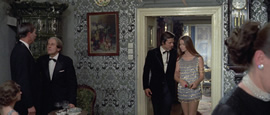 the atmospheric tricks of the narrative, ties to other thrillers of the era, and the social underpinnings of the story. A second commentary comes from actor Jürgen
 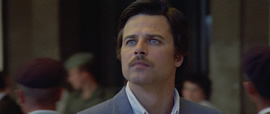 Drews (who gets to sing the eerie theme song in one street scene), who remembers an incredible amount of detail about being on the set and cheerfully greets many of the actors they appear and shares tales about hanging out with them. Both the Blu-ray and DVD sets are divided into two discs, with the main feature on disc one along with the English and Italian trailers (which are completely different from each other) and a portion of the extras. In the 21-minute "The Need to Sing," the wonderful Edda Dell'Orso (who performed all of that beautiful vocalizing in Ennio Morricone's scores) gives a warm, affectionate rundown of her musical career and her collaborations with the maestro over the years as well as other Italian musical legends. Next is a 23-minute featurette with editor Mario Morra called "Cutting Glass Dolls," in which he goes over doing mondo films for Jacopetti and Prosperi and handling the challenging editing of this film, which involved significant time jumping and some rapid-fire montages.
Disc two is a DVD in either edition and contains two additional bonuses. In the sprawling 97m6s "Czech Mate," Lado covers pretty much his entire career from his first writing assignment, Million Dollar Eel (which featured Adorf) through other titles like The Designated Victim and some westerns before jumping into his directorial career with this and other titles like The Night Train Murders, The Humanoid, and Who Saw Her Die? There's a huge chunk of time spent on this film including stories about writing the lyrics for the street song, his good relationship with Morra, the difference between shooting orgy scenes with old and young people, and the political ramifications of the film with its oft-repeated theme of the blood of young people sapped by the predatory upper class. His tirade about the crumbling European economic and political system is pretty astounding, too, and Sorel makes a cameo appearance as well. In "Einmal Italien Und Zuruck" (30m17s), co-producer Dieter Geissler goes over his love for film (sparked with a screening of Metropolis), his entry in the business as an actor, and his switch to producing with this, Ludwig, and other international productions, with Italian producers presenting their fair share of problems. He also reveals that Terence Hill was the original choice to play the lead here, which is fascinating to contemplate, and explains where the heck that Malastrana title came from. 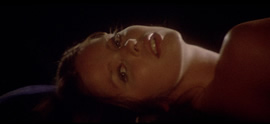 An 18-minute reel covers the substantial portions of Lado's French commentary, finally with English subtitles; it mainly covers the production basics of the six-week shoot with a few tangents like the similar Stephen King story "Autopsy
  Room Four" published many years later. There are also a couple of Easter Eggs, including a crazy little 5-minute Easter egg with Lado getting argumentative about the strange meaning of Bach's character name and calling the interviewer a "crafty old devil," followed by an excerpt from his French commentary in which he completely contradicts himself and then shares another anecdote about the more obscure film, Red Kiss. In the other hidden bonus, Dell'Orso appears for another two minutes to talk about her general thoughts on music. The typically sturdy slipcase packaging also includes a booklet with liner notes (in German and English) by Kai Naumann, who runs down the film's shifts in narrative perspective, the role of Prague and the historical and symbolic weight it carries, and the influence it had on some much more famous later art films and thrillers. Just after that release, anyone who wanted the English track but with virtually no extras (apart from the English and Italian trailers) could content themselves with the 2016 U.K. Blu-ray from 88 Films or the 2018 U.S. Blu-ray from Twilight TIme (which added a commentary with David Del Valle and Matteo Molinari and an isolated music track) from the same master.
In 2025 depending on which side of the pond you're on, you get two virtually simultaneous new releases on 4K UHD along with Blu-rays in both the U.K. and the U.S., both from a gorgeous new restoration with HDR10-compatible Dolby Vision on the UHD along with the English and Italian mono tracks (DTS-HD MA 2.0) with English-translated or SDH subtitles. The U.K. one was a definite upgrade from 88 Films which adds on an audio commentary (with Eugenio Ercolani, Troy Howarth, and this writer), "When Butterflies Turned to Glass" with Lado, a "Glass Doll Theories" video essay by Pier Maria Bocchi, a "Lado’s Trilogy of Terror" video Essay by Mike Foster, an appraisal by Stephen Thrower, the archival Dell'Orso, "Czech Mate," and Geissler pieces, and "Cutting Glass Dolls" with editor Mario Morra. The massive four-disc(!) edition from Celluloid Dreams features one UHD and three Blu-rays, and direct orders also come with an original 10-frame filmstrip of 10 frames (newly printed from the trailer's original camera negative) and a set of 12x8.25" color reproductions of the original Italian fotobuste (lobby cards).  The film itself looks better than ever, pulling back on the somewhat harsh white highlights of the earlier HD scan and featuring more consistent flesh tones and a moodier, more delicate, shadowy appearance. The French-language commentary with Lado and Caddeo is here with English subtitles and is always worth a listen (especially the early account of covert shooting in Prague), while Guido Henkel provides a new commentary that's easily up to par with his stellar
  work on the label's earlier Case of the Bloody Iris. His eye for detail is exceptional as he points out uncredited bit players, curious aspects of locations and behavior in the extras, possible readings of the visual symbols, and tons more. Both the UHD and first Blu-ray also have the Italian and English trailers, a "grindhouse" (i.e., scruffy-looking) version of the Italian trailer, and a very cool previously unseen English trailer under the title Catalepsis.
Disc three (or Blu-ray two if you prefer) is devoted to the bulk of the video bonus features kicking off with "The Nights of Malastrana" (101m8s), a revised version of the "Czech Mate" piece with Lado. The new "All About Lado" (32m32s) is a 2018 interview with the filmmaker covering his general career from his early cinematic inspirations to his other artistic pursuits, his extensive work in France, and his path to becoming a director in Italy. The Doria, Geissler, Morra, and Dell'Orso interviews are all included here (the Morra one called "Cuts Like a Knife" now), while the new video essay "The Man on the Bridge: Philosophy, Perception and Imprisonment in Aldo Lado's Short Night of Glass Dolls" (23m3s) by Howard S. Berger deftly ties together the role of Prague and its history in the film, the separation of mind and body here found in other literary works, visual cues taken from expressionistic art, and much more. Also on the disc are German VHS-sourced alternate credits as Malastrana and a 74-image gallery of posters, stills, lobby cards, and other odds and ends. Disc four is a curio featuring two "grindhouse version" options from a 35mm archival lab print, viewable in Italian with optional subtitles or with the English track, or for the masochistic, the Paralyzed VHS preserved in all its cropped glory with alternate white on black credits. The study hardbox packaging also has a hefty illustrated booklet (dedicated to Lado, who passed in 2023) featuring an essay by Andy Marshall-Roberts ("Who Saw the Glass Dolls on the Night Train?") about the filmmaker's key works, some very peculiar critical reactions from the initial release, and extensive restoration notes.
CELLULOID DREAMS (Blu-ray)


CAMERA OBSCURA (Blu-ray)


Updated review on April 9, 2025
