The most restrained and eloquent of Rollin's '70s vampire saga, Lips of Blood (Lèvres de sang
In the opening sequence, a middle aged woman supervises the ceremonial placement of a still breathing girl into a coffin, which is then sealed and left in a subterranean room. Flash forward to the present day, in which Pierre (co-writer Jean-Lou Philippe) is plagued by visions of a childhood in which he encounters a beautiful girl in white. He spends the night under her care in a decaying castle, and she releases him in the morning, only to find the gate slammed in her face. He believes these visions are actually memories from his boyhood, but his mother dismisses such thoughts, claiming he should go see a doctor. At a reception for a new brand of perfume, he stumbles upon a promotional shot of a castle which strongly resembles the one in his visions. The photographer responsible for the shot
Aside from a few passages, Lips of Blood contains very little dialogue and maintains a surreal, dreamlike stance throughout its running time. The final half hour is Rollin at his best, with an unbearably poignant beachside finale that perfectly sums up his themes as a director. The bizarre locations, ranging from modern day offices to an abandoned nocturnal aquarium, mark the film as a transition piece from his dislocated vampire fantasies to his more realistic later horrors like The Grapes of Death. The familiar Castel twins make another appearance but have little to do besides licking blood off their lips in striking surgical outfits and transparent gowns, and most of the actors perform in a deliberately somnambulist fashion reminiscent of Werner Herzog. A difficult, often enchanting film, Lips of Blood will most likely reward viewers already well versed in Rollin's powerful alternate universe.
The first special edition arrived in 2005 as a whopping three-disc European limited release from Encore, carrying a rather steep price tag but worth the investment for Rollin fans. The subsequent American release from Redemption carries over the same superb anamorphic makeover, resulting in a sharp and colorful transfer up there with the best Rollin releases on the market. The Redemption one also condenses the lion's share of the extras onto one disc, making it a preferable option for those concerned about their budget and shelf space. So, here's what's on the U.S. disc: an audio commentary by Jean Rollin (in his usualy heavy French accent, but he offers some nice recollections about the Parisian locales and working with the actors, particularly Philippe who went on to infamy in Pussy Talk), a stills gallery, video interviews with Philippe and Perrey (both English-subtitled and covering their careers as much as this particular film), a video intro by Rollin, and a batch of Redemption cross-trailers. (No theatrical trailer for this film has yet to surface, alas.) Should you choose to seek out the three-disc version, it also adds on additional interviews with Serge Rollin and Cathy Tricot (one of the Castel twins) as well Rollin's short film "Les Amours Jaunes" and a video trip back to the climactic beach locale.
The Blu-Ray release from Redemption under the new hand of Kino Video offers an appreciable jump thanks to the increased clarity of HD, derived from what appears to be the negative used for the Encore release (including the textless opening sequence). The DVDs were great to begin with, but this one is even better with an immersive, rich visual texture and some nice details previously invisible in standard def like the books and production design touches in the modern apartment and the expressionistic bursts of red lighting in the background of some of the graveyard sequences. This version doesn't even try to compete with the Encore version, though it easily surpasses its US predecessor thanks to a Rollin video intro, a 9-minute interview about the director with Natalie Perrey, an illustrated booklet with informative and appreciatve liner notes by Video Watchdog's Tim Lucas, and trailers for the first five Kino/Rollin titles, this one included.
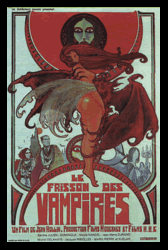
While Jean Rollin directed two experimental vampire films before this one, Shiver of the Vampires (Le frisson des vampires) fully established the visual motifs and overall stylistic approach to which he would return for most of his subsequent horror efforts. A blatant homage to the erotic/horrific comics and serials of which Rollin is so fond, Shiver played more widely than prior Rollin titles in various countries under so many alternate versions that trying to assemble a genuine, complete cut has become virtually impossible. The plot, to use the term loosely, finds a newlywed couple arriving at a castle populated by mysterious lovely women and two hippie hosts. Their odd but uneventful stay is interrupted when a strange, amazonian vampire (Dominique) steps out of a tall grandfather clock at midnight and exerts her bloodthirsty influence on the other vampiric inhabitants. Like most Rollin films, this winds up on a beach for one of his traditional visually striking, melancholy finales that linger in the mind long after the film is over.
Drenched in bizarre, candy-colored lighting which predates Dario Argento's Suspiria by at least six years, Frisson is still one of its creator's most visually intoxicating works. The extremely thin storyline only has the slightest relationship to the actions onscreen, which tend to involve various performers falling into sexual and vampiric poses. In an attempt to make this film as commercially viable as possible, distributors have inserted new scenes, thrown in outtakes, and hacked away entire sequences to create a number of wildly different variations. One English-language version, Sex and the Vampire, runs as short as 75 minutes, while a longer English cut, Thrill of the Vampires, contains some additional S&M footage thrown in for extra salacious value. Most European video collectors first became acquainted with this film on the gray market thanks to a Spanish-language release, which features some alternate dialogue and sex scene takes as well as a different (and quite good) music score in its bookending sequences with a funky Pink Floyd flavor. The original French score by the amateur group Acanthus is wild and consistently amusing progressive rock, as garish and outre as the irrational lighting schemes.
The DVD contains the original French language version with optional English subtitles. The film is slightly letterboxed, revealing the maximum amount of image available, and easily outclassses any other version available before; extras consist of a director filmography and both the English and French European trailers (identical except for the text cards). A later two-disc edition from Encore is one of their more modest efforts as far as Rollin goes, but it's worth it for completists thanks to some of the aforementioned alternate scenes and a 16-minute selected scene commentary with Rollin. The subsequent Blu-Ray edition from Kino under the revampted Redemption banner is easily the most visually impressive of the bunch, finally capturing those wild red-drenched sequences in all their fiery glory compared to the more muted tones of the standard def releases. It's pretty spectacular, and the transfer was done with an absolute minimum of digital interference. This also means you'll see a few white specks here and there, but it's not much of a distraction. Extras include a brief two-minute video intro by Rollin (presumably excerpted from another longer piece), a lengthy 41-minute video chat with the director from 2004, the English and French trailers, and trailers for the four additional Kino/Rollin Blu-Rays in the initial batch, along with a booklet containing the usual excellent liner notes by Video Watchdog's Tim Lucas.
When is a Jean Rollin vampire film not a vampire film? The answer: Fascination, a riveting, highly unorthodox of the blood drinker mythos for which Rollin gained financing through a few adult film quickies. Though extremely low budget, the result is one of his finest, most elegent accomplishments and one of the safest introductions to Rollin's style.
After a haunting, cryptic opening in which several well-to-do French ladies gather at a farm where animals are being slaughtered and daintily sip glasses filled with blood, the story follows the misadventures of blond hoodlum Jean-Marie Lemaire, who holds up two young women (Brigitte Lahaie and Franca Mai) at an isolated chateau. The two women apparently have little to do during the day besides rolling around on the rug for an occasional lesbian dalliance, so this turn of events turns out quite unexpectedly for our antihero. Along with The Living Dead Girl, this film remains the director's purest and most successful of the feminine mystique channeled directly through the gothic tradition. Coming right off her stint on Rollin's The Grapes of Death, former adult film actress Lahaie makes a fine, memorable figure, tromping around semi-nude in her black cape and slashing open trespassers. The new Image DVD of Fascination presented by Redemption is by far the cleanest and most visually impressive rendition of this film, though the only real past competition is the prior edited tape released by Redemption in the U.K. and ragged, smudgy-looking SECAM prints released in France. Actually, the DVD is so clear that it reveals some flaws in the source material, indicating that Rollin's personal print has also suffered some slight ravages of time. Some slight, minor staining on the print flickers in and out for a few minutes, but it's not enough to detract from the beauty of the film or the clarity of its presentation. Of course, since this film was shot on an impoverished budget (most likely on substandard film stock as well), it will never have the crisp, ultrasharp clarity of other films from the period. The sound quality of the film has never been spectacular, but the audio here is pleasant and distortion-free, with Philippe D'Aram's beautiful score seeping over the decadent imagery like a bloody veil. Considering Fascination's history and the awful versions fans have had to settle for in the past, this DVD is a sight for sore eyes and should serve as a nice aid for introducing new viewers to Rollin's strange, wonderful cinematic world. Mercifully, like the other Rollin titles, the DVD omits those irritating Eileen Daly intros and focuses more on the extras: a photo gallery of production and promotional shots, as well as the original French trailer (which contains some alternate sexy close-up shots trimmed from the final cut of the film).
The Kino Blu-Ray (branded as Redemption, per usual practice) is truly lovely, with an attractive film-like texture and much more detail than SD could capture. It's still a fairly soft and powdery-looking film compared to some of Rollin's other works, but it's definitely a substantial improvement. The negative has been left untouched here, which means you'll see some filmic debris here and there. The most interesting extra is a pair of very extended sex scenes with Lahaie, both softcore but treading close to the edge with a handful of shots. The excellent Mondo Macabro TV episode "Virgins and Vampires" devoted to Rollin is included here in its entirety, with many of the film clips substituted with their new HD upgrades. (The framing of the interview sequences is also a little horizontally stretched now, which is a tad distracting.) The usual five Rollin Blu-Ray-related trailers are also included along with liner notes by Video Watchdog's Tim Lucas.
Directed by Jean Rollin
Starring Jean-Lou Philippe, Annie Belle, Nathalie Perrey, Martine Grimaud, Catherine Castel, Marie-Pierre Castel, Helene Maguin
Kino Lorber (Blu-Ray & DVD) ( US R0 HD/NTSC) / WS (1.66:1) (16:9), Redemption (US R1 NTSC), Encore (Holland R0 PAL) / WS (1.78:1) (16:9), Image (US R1 NTSC) / WS (1.66:1)
 ) drags his familiar beautiful bloodsuckers into a modern day context, focusing more on the psychological underpinnings of the vampire mythos than the simple images of naked women chomping on victims' throats. Perhaps for these reasons, Lips of Blood quickly became one of the most difficult of Rollin's horror titles to see, a situation eventually corrected on DVD with a much overdue reappraisal of his work.
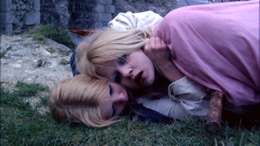 arranges to meet him at midnight; when he waits for her in a local cinema (showing Shiver of the Vampires), he spies the same girl in white and pursues her to a basement, where he unintentionally unleashes a quartet of scantily clad vampires on the city. As the quest for the girl and her strange castle continues, he finds himself constantly thwarted by his family and the nubile vampires, who for some strange reason refuse to kill him. The truth, alas, is much stranger than he could have possibly imagined.
 All of the three transfers of Lips of Blood available on DVD have been derived from original negatives and, naturally, look fantastic. The oldest release from Image (now discontinued) obviously suffers the most given its early placement in the development of DVD, though it was satisfactory for its time. (It also offers a hair more picture information on the top and bottom by presenting the 1.66:1 camera framing rather than the slightly tighter 1.78:1 presentation of its successors, bu the film works fine either way.)
Directed by Jean Rollin
Starring Sandra Julien, Michel Delahaye, Dominique, Jean-Marie Durand, Nicole Nancel, Marie-Pierre Tricot, Kuelan Herce, Jacques Roboilles
Kino (Blu-Ray & DVD) ( US R0 HD/NTSC), Encore (Holland R0 PAL) / WS (1.66:1) (16:9), Image / Redemption (US R1 NTSC) / WS (1.66:1)
 However, this edition from Image and Redemption is purportedly Rollin's personal preferred cut, and at 95 minutes, it remains the longest and most purely "Rollin-esque" edition available.
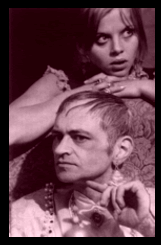 Extremely long, non-dialogue passages provide some beautifully poetic moments seething with gothic malaise and decay, a treatment which would reach its zenith in Requiem for a Vampire. Though not his most polished effort by a long shot, Shiver is really where it all started and remains an important contribution to European vampire cinema.
Color, 1979, 83m.
Directed by Jean Rollin
Starring Brigitte Lahaie, Franca Mai, Jean-Marie Lemaire, Fanny Magier, Muriel Montosse, Sophie Noel
Kino (Blu-Ray & DVD) ( US R0 HD/NTSC) / WS (1.66:1) (16:9), Image/Redemption (US R1 NTSC) / WS (1.75:1)
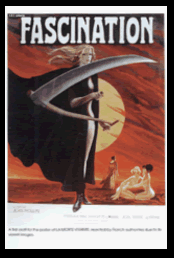 When another group of ne'er-do-wells shows up, Lahaie takes a scythe to them, and as the prologue has already indicated, turn of the century French women were not quite as naive and innocent as most commonly believed. Like most Rollin films, the ending is both tragic and haunting, with a highly memorable final image and line of dialogue.
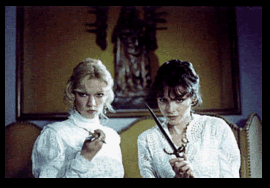 Not surprisingly, the actors have little opportunity to do more than serve as gorgeous set decoration; the subtitled dialogue is almost extraneous. The sex scenes are more intense and explicit than Rollin's previous horror outings but remain suffused with a heady surrealism that makes the encounters play like animated works of art. Surprisngly, the women are not technically vampires but, according to Rollin, were derived from a true anecdote concerning a small female blood cult among the rich and bored. Thus, the film plays more like a pastoral version of the blood-bathing Elizabeth Bathory saga with the eroticism aspects pushed up to full throttle (a la Borowczyk's Immoral Tales).