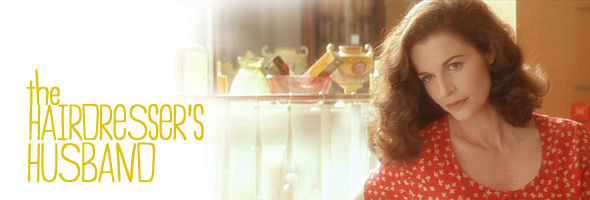
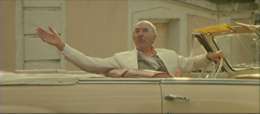
Fond of dancing and the ocean where he grew up, Antoine (Jean Rochefort) has always been enamored with beautiful hairdressers. While some men develop fixations on, say, nurses or cheerleaders, he remains firmly fixed on the idea of marrying a hairdresser and finally finds his dreams coming true when he meets Mathilde (Anna Galiena), who agrees to become his wife. Their idyllic existence consists of Antoine's joy watching his woman at work on her quirky clients, often indulging himself in his little dances or mixing her salon activities with more intimate pleasures. However, Antoine's wide-eyed fixation is about to take a very unexpected turn...
Even shorter than Leconte's previous film, The Hairdresser's Husband is an oddly compelling film in that there's very little forward narrative (if you break it down, there's barely more narrative thrust than My Big Fat Greek Wedding), yet the wonderful scope photography by Eduardo Serra (Unbreakable) and lyrical score by Michael Nyman (with a few Arabic numbers thrown in) creates an intoxicating ambience. Of course, the essential component here is the unlikely but magical chemistry between Rochefort and the stunning Galiena (also seen in much saucier fare like Jamon Jamon and
Initial VHs and laserdisc editions of the film were a complete waste, hacking the compositions into fragments and completely destroying its visual elegance. The inital DVD out of the gate came from the UK, but Second Sight's presentation only letterboxed the film at 1.78:1, barely an improvement and still way too claustrophobic. Still, this version does contain a nice Leconte short film, "La Famille Heureuse," which never surfaced on any of the other discs. The French release restores the original framing but features PAL speed up, which in this case has a detrimental effect on the music score; it also features a different Leconte short ("Le Batteur du Bolero") and a one-hour interview with Leconte and a much shorter piece with Serra, but these are French only with no sub options.
The eventual American DVD from Severin dispenses with the short films but more than makes up for it with the best transfer of the bunch, featuring very rich colors, progressive flagging and perfect framing. It still looks like an early '90s European film and often has a hazy veneer, but that's part of the original aesthetic. All versions indicate a Dolby stereo soundtrack, but channel separation is extremely minimal. The Severin disc includes a theatrical trailer, a new and very pleasing, tightly-edited 36-minute Leconte interview with English subs covering his career from his early comedies up to this film, and a terrific 17-minute video interview with the still-lovely Galiena, who talks about going after their role thanks to viewing Monsier Hire, her thoughts on eroticism in her film roles, and her prior work with Claude Chabrol. A very solid and worthwhile DVD all around.
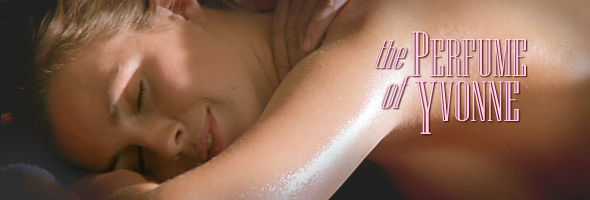
Based on the novel Villa Triste by Patrick Modiano, the bulk of the story is told in flashback by Victor (Hippolyte Girardot), a young man who passes himself off as a count in Geneva while draft dodging service in the Algerian War. He becomes entangled with Yvonne (one-off actress Sandra Majani), a beautiful actress, by striking up a friendship with her flamboyant traveling companion, Dr. Meinthe (Jean-Pierre Marielle, out-camping his gay detective role in Four Flies on Grey Velvet). However, as we already know the outcome is not pretty, their affair is doomed to have a very short shelf life.
Severin's DVD offers a superior encoding of the film compared to the UK disc; the powdery color schemes of the flashbacks look terrific, and the scope compositions appear to be accurately rendered. The big extra here is the second half of the Leconte interview, which picks up with this film and Tango and then progressing on to his later films, almost all of which found international favor. Hopefully Severin's two much-overdue American releases of his films will also encourage film fans to seek out his later films, which include such flat-out masterpieces as Girl on the Bridge
Directed by Patrice Leconte / Starring Jean Rochefort, Anna Galiena, Roland Bertin, Maurice Chevit
Severin (US R1 NTSC), DVDY (France R2 PAL) / WS (2.35:1) (16:9), Second Sight (UK R0 PAL) / WS (1.78:1) (16:9) (16:9)
 After working as a gun for hire on a string of French comedies, director Patrice Lectone finally came found his real voice during the art house boom of the late 1980s with his short and evocative neo-noir, Monsieur Hire, his first title with notable international exposure. A perfect fit for the age of studios like Miramax, he followed up this success with a more benign look at obsession, 1990's The Hairdresser's Husband (Le marie de la coiffeuse), which was marketed as a sunny, spicy import for romantics. As usual with Leconte, there's quite a bit more here than meets the eye.
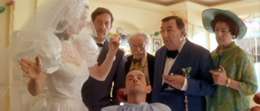
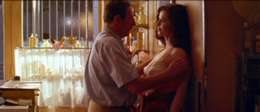 Tinto Brass' Black Angel), who make a dazzling screen couple. It's difficult to discuss the film more without revealing the surprising ending, a tonal shift that caught many audiences off guard and demands a second viewing to reasses the true emotional nature of everything from the beginning. In any case, it's an essential French film whose disastrous home video history in the U.S. has finally been corrected well into the DVD era.
Directed by Patrice Lectone / Starring Jean-Pierre Marielle, Hippolyte Girardot, Sandra Majani, Richard Bohringer
Severin (US R1 NTSC) / WS (2.35:1) (16:9), Second Sight (UK R0 PAL) / WS (2.35:1) (16:9) (16:9)
 Between the successes of The Hairdresser's Husband and Ridicule
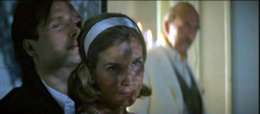 In an interesting contrast, Yvonne features a much younger male protagonist but feels much more world weary and melancholy; some viewers find this approach thoughtful and poignant, while others just find it aimless. The two romantic leads are definitely among the chilliest in Leconte's repertoire, but the sex scenes (which are among the filmmaker's most revealing) and overwhelming sense of tragedy certainly make it linger in the memory.


