
B&W, 1965, 83m. / Directed by Jess Franco / Starring Estella Blain, Mabel Karr / Mondo Macabro (US R1 NTSC) / WS (1.66:1) (16:9)


Following the success of his debut horror film, 1962's The Awful Dr. Orlof, Jess Franco continued his string of kinky, black and white gothics with memorable variations on the same theme: The Sadistic Baron von Klaus, Dr. Orloff's Monster, and the greatest film of his early period, The Diabolical Dr. Z (also shown in Europe under the more appropriate title of Miss Muerte, as Dr. Z exits the film ten minutes in). With this film Franco established many of the themes and obsessions which would continue through his color films of the '60s and '70s, including erotic stage shows with mannequins, beautiful women programmed to kill, a bereaved loved one avenging a tragic death, and fetishized body appendages used to kill. An ideal starting point for newcomers terrified of Franco's reputation, this beguiling mixture of drive-in sleaze and European art film remains one of the director's most purely enjoyable and accessible efforts.

During a thunderstorm, the soon-to-be-executed Woodside Strangler attacks his guard and escapes from prison, only to arrive barely conscious at the estate of bespectacled Dr. Zimmer (Antonio Jiménez Escribano), a disciple of the late Dr. Orloff. At the insistence of his daughter Irma (Mabel Karr), the doctor tries out his new mind control experiments on the convict thanks to his latest contraption, a robot-armed mechanism complete with spikes which puncture the patient's spinal column. Zimmer presents his findings at a scientific conference, but the hostile reception from his colleagues drives Zimmer to a fatal heart attack on the spot. To cope with her grief, Irma goes to a jazz club where the beguiling Miss Death (Estella Blain) performs a bizarre stage routine involving a huge spiderweb. Consumed by the need to continue her father's experiments, Irma runs over a sexy blonde hitchhiker but winds up horribly scarred while disposing of the body. When the doctor's female assistant rebels, Irma uses the Strangler (now her mind-controlled servant) to subdue the rebellious woman and turn her into a servant, too. Together they set out after Miss Death (real name Nadia) in order to create a killing machine capable of striking down the men responsible for Zimmer's death. The method is simple; with her long, poisonous fingernails, Miss Death can seduce her prey in any location without being caught, and soon this instrument of terror sets out after the three guilty parties with the police gradually closing in.

The subject matter is top grade lurid Franco, complete with nasty surgical procedures, jazz fugues, and even appearances by Franco and composer Daniel White as police inspectors. Even Dr. Orlof himself, the always reliable Howard Vernon, pops up in two scenes as the ill-fated Dr. Vicas, who meets his fate aboard a speeding train in one especially peculiar setpiece. As the beautiful Nadia, Blain has some of the film's most memorable moments and effectively carries her scenes largely through facial expressions. Her capture at Irma's hands while wearing a skin-tight spider outfit is one of the film's more eye-catching moments, but here Franco keeps the cinematic virtuosity coursing throughout the narrative without losing sight of his story. The climax is one of his best, with a bravura castle fistfight which begins with a smashing tracking shot down a stony hallway, intercuts a brilliant series of punches, and climaxes with a staircase sword duel. Despite one phony-looking shot of a scalpel slicing Irma's face and Miss Death's skimpy costumes, this is also a rare Franco film able to be shared with younger or more squeamish horror fans who might want to see what all the fuss is about. More seasoned Franco viewers will be curious to see his first run through a plotline (itself inspired by Cornell Woolrich's The Bride Wore Black) later revisited and revised in such films as She Killed in Ecstasy and Eugenie De Sade, while the visual parallels to the next year's Succubus and even his controversial shot-on-video projects like Tender Flesh and Mari-Cookie and the Killer Tarantula should be glaringly obvious.

After years of ignominious public domain treatment, The Diabolical Dr. Z comes to DVD in high style courtesy of Mondo Macabro. The anamoprhic transfer looks smashing, with excellent contrast and detail. Element damage is almost nonexistent, and the source (taken from the original French-language edition) betters all previous versions. A handful of shots near the beginning display some minor blurring and streaking in the forest sequence, but this may be a fault of the original film processing. The disc contains both the English and French language versions; both were looped in keeping with Franco's filming tradition at the time, but since this version runs slightly longer than the U.S. English language cut, the English track includes a bit of French dialogue (with optional subtitles) to keep the flow intact. The French version from start to finish is really the classier and smoother of the two options and comes highly recommended. The packaging indicates a stereo soundtrack, but it sounds like plain old mono, albeit very crisp and clear.

As for extras, the disc includes the U.S. title sequence (not significantly different from the European one, but a nice extra all the same), the U.S. theatrical trailer, a still and poster gallery, and talent bios. Perhaps the most worthwhile but peculiar bonus is "The Diabolical Mr. Franco," a 15-minute featurette in the vein of the Mondo Macabro TV show containing Franco interview footage interspersed with comments from the likes of Peter Blumenstock. For some reason Caroline Munro pops up for a half-sentence cameo that looks like an editing error. The disc comes with a cover built around the original French poster art and contains some nifty animated menus, all revolving around a spiderweb motif, of course.


Color, 1999, 90/67m. / Directed by Jess Franco / Starring Analía Ivars, Rachel Sheppard / Sub Rosa (US R1 NTSC) / DD2.0
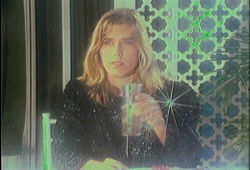

Jess Franco whirls out a video generation lesbian remake of his haunting Female Vampire in the form of Vampire Blues, a free-association romp better appreciated by Franco fans than casual horror viewers. More of an extended music video filled with Franco's trademark directorial quirks and fetishes than a narrative film, this should be familiar terrain for Eurotrash veterns looking for their latest fix from the master of Spanish sleaze.

While lounging topless on the Spanish coast, Rachel (Rachel Sheppard) catches the eye of seductive Countess Irina (Analía Ivars), a vampire prone to hugging trees, dancing behind huge glass bottles, and fondling herself through pink boas. Tormented by dreams of the devilish countess, Rachel is further puzzled when she sees the woman's likeness on a T-shirt peddled by a souvenir salesman (played by Franco, of course). She then takes in a nightclub show where the main attraction, psychic gypsy Magda (Linda Romay, who stays mostly clothed for once) proclaims, "Yew arrrre from New Errrk, New Jeerrsey!" Rachel, her slip-sliding accent notwithstanding, naturally replies, "If you mean Newark, New Jersey, yes." Magda then reveals she knows all about Rachel's visions and has even visited the girl herself in dreams. Furthermore, she knows how to stop the bloodsucker, thanks to the most unorthodox vampire "staking" in movie history.
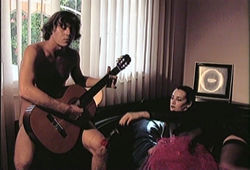
As with his other shot on video projects like Tender Flesh and Mari-Cookie and the Killer Tarantula, Vampire Blues is saddled with a nonexistent budget and amateurish sound recording, which doesn't help much with the actors' already thick accents. Of course, none of this will matter to Franco fans, who could probably bear anything after wading through sludge like Lust for Frankenstein, from which this is definitely several steps up. Fortunately Franco mostly plays to his strengths here and focuses on long, non-dialogue passages scored with funky lounge, jazz, and blues riffs, while the actresses do their thing. It's odd to think that this director once splashed his kinky visions across international cinema screens in lush scope and Technicolor, but at least he's still cranking 'em out well into his days as a senior citizen. As usual Romay is intriguing to watch (especially in her freaky gypsy make-up) and Ivars makes a slinky vampire, but Sheppard gives a clumsy non-performance that would make porn actors wince. She's almost enough to make one pine for Amber Newman.
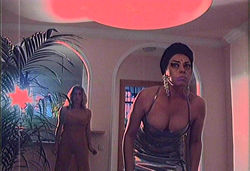

As with other later Franco titles, Vampire Blues is presented in both a streamlined American cut (67 minutes) and a longer European version (90 minutes), the latter basically containing more langorous camerawork and extended crotch shots. Video quality is wholly dependent on how much visual distortion Franco cranks into the picture; scenes are often suffused with chroma effects which turn the screen into a riot of tropical colors. The surround audio sounds fine when the music's playing, at least. The disc also includes a dupey-looking "Vampire Blues" music video by The Ubangis, a candid photo gallery, and the usual Sub Rosa promo reel. The packaging indicates a "behind the scenes," which may have been left off unless it's an exceptionally well-hidden Easter egg.


Color, 1976, 98m. / Directed by Jess Franco / Starring Klaus Kinski, Josephine Chaplin / VIP/Image (US R1 NTSC) / WS (1.78:1) (16:9)


One of the rare post-'60s Jess Franco films to receive a significant theatrical stateside release, Jack the Ripper offered the promising collaboration of Spain's wildest director and Germany's most unhinged actor, Klaus Kinski. The results are actually more sedate than one might expect, especially given that Franco's script tosses out any similarity to the actual crimes committed by Saucy Jack apart from the Victorian English setting and the concept of a serial murderer preying on prostitutes.

The story begins well into the Ripper's reign of terror, as another prostitute falls victim to his blade on a foggy evening. With only the aural testimony of a blind man to go on, Scotland Yard has nary a clue to track down the psychopath, who actually turns out to be semi-respectable Dr. Dennis Orloff (Kinski). While fishermen are busy fishing lady's body parts out of the local river (which looks suspiciously more like an outlet from the Danube than the Thames), the good doctor endures horrible flashbacks to his childhood (involving his hooker mother) and goes out on killing sprees, aided by his complicit housekeeper. Eventually Scotland Yard gets wise to the doc's nocturnal activities, and in a plot turn swiped from Mario Bava's Hatchet for the Honeymoon, the chief inspector's girlfriend (Josephine Chaplin, fresh off Pasolini's The Canterbury Tales) is pressed into service to pose as a potential victim.

Though laced with occasional bursts of nudity and gory bits partially created with ceramics, Jack the Ripper is a relatively upscale and classy affair for Franco. His usual sedate pacing is functional given the attractive setting for his camera to probe, though it's strange to see Kinski tackling such a meaty role with so little interest. His eerie eyes and expressions are put to good use, but even when he's ravishing the freshly expired bodies of his victims, the actor's expected hysteria never surfaces. Franco regular and future wife Lina Romay (still at the height of her beauty) turns up for the film's most memorable (and gruesome) extended setpiece, as a dancehall girl who winds up taking a fatal moonlight stroll with Kinski.

This Swiss disc supervised by the film's producer, Edwin C. Dietrich, marks an auspicious beginning for his propsed line of Franco DVDs. The meticulously restored image quality is nothing short of remarkable, with detail and colors so vivid the film could have been shot this year. A couple of bootleg DVD companies (e.g., Diamond) have passed off their own sorry looking renditions of the shorter U.S. print of this film on DVD, but accept no substitutes; this one really delivers. Dietrich also offers a reasonably interesting commentary track focusing on the technical and production angles, though the absence of Franco (reportedly not his best buddy in the world) is a shame. Extras include the theatrical trailer for both Jack and Franco's excellent Love Letters of a Portuguese Nun (both in German) as well as a restoration featurette, a documentary featuring Dietrich discussing the film and his relationship with Franco, and a 16mm excerpt of the oft-published deleted shot of Romay's mutilated body. Language options include German, French, Italian, and the clumsy English dub track, which ranks up there with The Stendhal Syndrome as one of the most awkward in the Eurocult annals. Unfortunately subtitles are only present in Dutch, Finnish, and Greek, with English translations for Dietrich's commentary. The set is rounded out by a host of production and location shots. A terrific start, to say the least; bring on more Franco!


Color, 1974, 94 mins. / Directed by Jess Franco / Starring Jess Franco, Lina Romay / Synapse (US R1 NTSC) / WS (1.66:1) (16:9)


Though the title conjures up images of a dubbed Exorcist imitation replete with levitations and chanting priests, this early '70s concoction from Jess Franco is actually something far more personal and unsettling. Though his earlier work was certainly no stranger to combining sex and violence in abnormally high doses, Exorcism (or as it was known in its first European incarnation, Exorcismes et Messes Noires) pushes the director into non-commercial territory by serving up one helping of depraved activity after another, linked by only the thinnest connective tissue of a plotline.

The film begins with a protracted eight minute sequence in which a nude Lina Romay, transfixed to a wooden cross, is tortured by elegant blonde Catherine Lafferiere, who knifes a dove and smears her victim with its blood. However, this display is merely pretend, a theatrical mass performed for an appreciative, decadent nightclub audience. However, so-called priest and recent mental patient Mathis Vogel (Franco) finds these displays representative of a demonic disease spreading throughout society, and he means to purge these demons at any cost. He writes stories for a local publication (where Romay happens to work as a secretary and dabbles in lesbian affairs during her off hours), but his real crusade involves the purgative deaths of corrupt souls. Meanwhile the police investigate the insidious crimes with the aid of a virile writer (The Midnight Party's Pierre Taylou) from Franco's office, leading to a final showdown over the future of Romay's soul.

Set in a dark, deadly Paris seemingly populated exclusively by selfish, deluded nutcases, Exorcism works best as a look at the dark side of the free, swinging attitudes popular at the time. Swingers clubs, orgies, and even one on one bedroom encounters have a tendency to hide nasty secrets; it actually makes sense that Vogel's deranged conception of himself as a sexualized angel of death could spring from this environment, but Franco clearly keeps the line drawn between fantasy and reality. Though produced as a hard mixture of simulated sex and violence, the Eurocine film was reissued with hardcore inserts (some performed by Franco himself, according to a Video Watchdog interview with company head Daniel Lesouer) which actually made the film even less erotic. The most widely seen version, Demoniac, appeared on U.S. video from Wizard in a heavily butchered version and actually represents an alternate 1979 edition with newly filmed plot exposition and additional sequences of Franco wandering around Paris. The "uncut" version of this variant, entitled The Sadist of Notre Dame, made the rounds in Europe and turned up somewhat more completely on U.K. video courtesy of Redemption. Now the "producer's cut" of this film from Eurocine has made its way to DVD courtesy of Synapse in what could be considered the most coherent of all possible versions. Cobbling together the export Exorcismes version with some additional footage from the vaults (some of which seems to have been prepared for Sadist, judging from the dialogue about Vogel's mental history), the disc contains the hardest possible footage without resorting to the jarring XXX inserts (which also marred the hard porn release of Franco's Female Vampire). Apart from the virtually nonstop nudity, this cut also contains the full entrail-ripping murder scene in which Vogel graphically knifes open one of his victims. In short, this is essential viewing for those interested in Franco, but some newcomers may be left scratching their heads as the film veers from one extreme to another. The only unquestionable failing of the film is its dialogue track, which was apparently recorded without sound and poorly dubbed in every possible language. The English version here is as sloppy and grating as it always has been, but Franco fanatics should know exactly what to expect.

Long available in a countless number of video editions both authorized and bootlegged, Exorcism has never looked better than it does here. Forget those colorless, badly edited dupes; the print material here is detailed and features nicely delineated black shadows with vivid color saturation, essential to an appreciation of the film's seedy, menacing texture. Some damage to the original film crops up during the opening sequence, which features some scratches and jumps throughout the credit sequence, while some of the original edits between shots were evidently done quickly on the cheap based on some noticeable shifting and jumping. The text for the credits seems to be equally careless, with inconsistent fonts (some not even properly placed on the frame) giving the false indication that something might be wrong with the film's framing. However, the anamorphic transfer itself (framed at the original European aspect ratio of 1.66:1) appears to be faultless and the mono soundtrack (sporting a nifty, sinister organ score) appears to be cleanly pulled from the negative, making this one of the most welcome and satisfying of Franco's DVD releases to date.

Of course, the big news for this disc is the first ever Franco commentary, which is about as strange, fascinating, and erratic as one could possibly hope. His English hasn't improved much over the years, but his comments moderated by current producer Kevin Collins are generally intelligible with close listening and an understanding of the questions from the adept moderator. Occasional lapses into silence are filled in with the film's soundtrack; however, Franco finds enough to say about the actors and the filming to make the experience worthwhile. Other extras include a lengthy theatrical trailer (under the Demoniac title), an alternate four minute version of the opening scene with both women fully clothed, a still gallery, and a nifty two-sided Amaray sleeve offering dual artwork options.


Mondo Digital ReviewsMondo Digital LinksFrequently Asked Questions