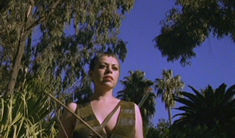
Color, 1983, 82 mins. / Directed by Jess Franco (as A.M. Frank) / Starring Manuel Gelin, France Jordan, Eric Viellard, Henry Lambert / Image / WS (1.76:1) (16:9)


As most Jess Franco fans know, his work took a decidedly weird turn in the late '70s and throughout the '80s. His combinations of outrageous gore and explicit sex on the tiniest of budgets are a far cry from the opulent (if equally idiosyncratic) films of the Harry Allan Towers era, but those willing to persist with the director's odd flights of fancy can find some odd bits of gold here and there. While Oasis of the Zombies is basically a work for hire Franco assignment filled with an outrageous amount of padding, it does offer a revealing glimpse of the manner in which Spain's most troublesome cinematic talent approaches a cut and dry genre film.

In the typical vague prologue, a pair of nymphets strolling hand in hand through a jungle (while showing off their early '80s bun hugger shorts, of course) pass by a hidden Nazi crate filled with gold. Unfortunately their idyllic afternoon is shattered when a pair of rotting hands burst from the earth, presumably dragging both of them to a slow, horrific death.

The source of this mysterious, guarded gold is soon revealed when young student Robert (Manuel Gelin) is summoned to the African desert following the death of his father. Along with some airhead friends, Robert goes through the effects of the deceased and uncovers a strange story (told in very long flashback) involving millions in Nazi gold buried in the sand, protected by hordes of undead soldiers from the Third Reich, and Robert's late mother, a shiek's daughter who died during childbirth. Naturally Robert decides to fulfill his father's quest and sets out to find this hazardous oasis, with a gang of fellow explorers in tow. Naturally the zombies are none too pleased when the infidels arrive.

A long way from the classy, intelligent zombie antics of Dawn of the Dead or Let Sleeping Corpses Lie, this film is more along the dumb but endearing lines of such disreputable gutmunchers as Bruno Mattei's Night of the Zombies. The Nazi zombie gimmick was evidently a popular one at Eurocine, who also used it in the more skin heavy Zombie Lake. In fact, Franco's original assignment to direct that film fell through, resulting in his helming of this one instead. The film was purportedly shot in both French and Spanish versions, though the former (usually dubbed in English) has been the easiest to find on video around the globe. International viewers have seen this under a wide variety of titles, such as Treasure of the Living Dead, Bloodsucking Nazi Zombies, Grave of the Living Dead, and Oasis of the Living Dead; the last of these was the version used for Wizard's out of print VHS edition. Likewise, cuts of this film have ranged wildly in content and running time, with one particularly guilty offender dropping all of the zombie footage!

This DVD, presented under the more marketable title of Oasis of the Zombies, comes closest to the original blend of Raiders-style exploration and gory horror envisioned by Franco, though that doesn't necessarily make it a "good" film. The finale is the real reason to wade through the slow stuff, as an army of zombies marches over the dunes through an oil fire at dusk and rips the encampment apart. Sure, the make up is still the same old half hearted latex and cereal mixture found in most '80s walking dead films (Lucio Fulci excepted, naturally), but there's a certain eerie power to Franco's gritty, gory visuals during this climax.

The image quality is about as good as this film could look, considering the limitations of the source. The colors are solid, and the letterboxing makes the film far less claustrophobic than the Wizard tape, which was an unwatchable eyesore. Some rough splices and scratches show up here and there, but most Franco fans will be delighted to see this frequently maligned black sheep getting the deluxe digital treatment. The English and French audio tracks are included in glorious mono. The back of the box indicates an alternate English opening credit sequence, but this is the one actually included within the print.


Color, 1970, 77 mins.

Directed by Jess Franco

Starring Soledad Miranda, Paul Müller, Howard Vernon, Ewa Strömberg, Jess Franco, Fred Williams / Image / WS (1.66:1) (16:9), Synapse / WS (1.66:1)


Returning once again for inspiration to the plotline of Cornell Woolrich's The Bride Wore Black, which had already at least partially inspired his Venus in Furs and The Diabolical Dr. Z, Jess Franco spins his most erotic take on a beautiful woman avenging a death by picking off the guilty parties one by one. The late slinky screen siren Soledad Miranda (Vampyros Lesbos) returned for the third of five collaborations with Franco before her untimely death, and her presence ignites what could have been another routine revenge potboiler.

A beautiful woman (Miranda) lives in bliss with her lover, Dr. Johnson (Fred Williams), who conducts unorthodox experiments with human embryos he keeps in jars around the lab. When a medical committee rejects his findings and orders him to discontinue his work, the unstable doctor does the only sensible thing: slashing his wrists in the bathroom. The devastated Miranda then takes it upon herself to seduce and kill the three men and one woman "responsible" for the suicide. Of course, two of the potential victims include Dr. Orloff himself, Howard Vernon, and Franco in one of his largest roles.

As dreamlike and Eurotrashy as Vampyros Lesbos, this film, also known as Mrs. Hyde, differs mainly in its adherence to a non-supernatural plotline. Miranda's erotic presence once again drives the film along even when the plot doesn't seem to be going anywhere, and her systematic seduction/murders are all memorable set pieces complete with plentiful nudity. (Unfortunately this also requires Vernon to get naked, so viewer beware.) German musicians Manfred Hubler and Siegfried Schwab (Vampyros Lesbos) return for another mindbending assemblage of funky grooves on the soundtrack, while the Mediterranean locales and pop art set design make this early '70s eye candy of the first order. Not a film for everyone, of course, but then Franco fans already know that.

Synapse's DVD of She Killed in Ecstasy (or Sie tötete in Extase) is essentially a cleaner, sharper rendition of the same print used for Redemption's U.K. video release. Apparently this is the best surviving material, though the image often contains hairline scratches and other telltale signs of age. It's a thousand times better than those old bootleg tapes, though, and has good, removeable yellow English subtitles. Not too shabby for a film nobody could even see a few years ago except in blurry, incomplete German dupes. The disc also includes the delirious original German trailer and some surprisingly explicit artwork of Ms. Miranda (actually taken from Franco's The Devil Came from Akasava, but does it really matter?). After the Synapse disc went out of print, an anamorphic revamp turned up from Image which benefits from the additional resolution and a slightly cleaner presentation, also with the German trailer.


Color, 1972, 101 mins.

Directed by Jess Franco

Starring Lina Romay, Jack Taylor, Jess Franco, Monica Swinn, Alice Arno, Jean Pierre Bouyzxou / Image / WS (2.35:1) (16:9)


The movie that most clearly separates director Jess Franco's career between the '60s and '70s, Female Vampire has been known under such a bewildering number of titles and alternate versions that few people have any idea which print could remotely be considered "definitive." Franco filmed a horror-oriented edition, The Bare Breasted Countess, in which his vampiric heroine feeds from her victim's necks, while the more erotic and potent variation presented here finds her aiming well below the waistline with her human prey. Either way it's an intoxicating film for those familiar with the European exploitation game and a maddening exercise in sensual excess for those who aren't.

Wearing only a black belt, boots, and a cloak, the mute and often nude Irina Karlstein (Lina Romay) strolls dreamily through a forest and approaches a hapless man at a nearby farmyard. What begins as a heated sexual encounter quicky turns nasty as her oral services literally drain him of life, killed at the height of passion. Back at her mountainside home, Irina indulges in all manner of perversions with her muscular servant (Luis Barboo), a few handy throw pillows, a bedpost, and an unlucky number of visitors. Meanwhile a visiting writer (Jack Taylor) becomes obsessed with his visions of Irina, whom he comes to regard as his destiny. Their eventual face to face encounter ignites a passion which can only reach one kind of climax: death.

While Franco himself pops up as the investigating Dr. Roberts (and teams up with a guy named Dr. Orloff, of course), the majority of Female Vampire is a virtually plotless study of overlapping visual images. The Mediterranean beach setting produces some uncannily weird results, with Irina's drives and the desolate seascapes producing a vampire film unlike any other (except perhaps Vampyros Lesbos, which introduced some of the nautical/vampire motifs earlier). Much of the film's power lies in the haunting jazz score by Daniel White, who scored many of Franco's finer films from this period, and the scope photography so often devastated in sloppy pan and scan transfers aids immeasurably in creating the film's all-consuming atmosphere of tragic lust.

As mentioned earlier, many variants of this title have been released over the years. Most video collectors encountered the vampire version as Erotikill from Wizard Video, while the naughtier cut was released as Loves of Irina from Private Screenings. The latter version was missing several sequences, particularly most of the explicit dungeon encounter with Monica Swinn. A third version entitled Les Avaleuses (or The Swallowers) featured crude hardcore footage of Romay (filmed much later) performing her skills on a variety of anonymous actors; virtually unwatchable and sloppily assembled, this cut is the least effective of the three. The Image EuroShock DVD of Female Vampire retains the ideal "sexy" cut of the film but sports a few oddities of its own. The dungeon footage and the entire ending are fully intact; the only discrepancy lies with Romay's oral servicing of Ramon Ardiz (her ex-boyfriend, incidentally), which contained some glimpses of semi-harcore fellatio in the Private Screenings and Redemption Benelux versions. This edition contains only profile shots of the scene, while the music continues uninterrupted. Otherwise the print is identical in content and is by far the best this film has ever looked. Transferred from the original materials in the Eurocine vaults, this film has never looked remotely this good anywhere else, with beautiful detail, accurate letterboxing, and rich colors. The level of detail is quite explicit, with some formerly obscured details of Ms. Romay's anatomy now, shall we say, unquestionably visible to the naked eye. The disc also includes all of the alternate Erotikill scenes, in which Romay shows off her ability to retain blood on her voluptuous lips, and the original French language theatrical trailer.


Color, 1997, 93 mins.

Directed by Jess Franco

Starring Amber Newman, Monique Parent, Lina Romay, Alain Petit, Analia Ivars / Seduction Cinema / WS (1.78:1)


As most European exploitation fans now acknowledge, the films of director Jess Franco divide into clean, separate categories, with his first two periods during the '60s usually cited as the best. His output since the early '90s has been much slower and more erratic than usual, with hardcore porn and shot-on-video projects consuming most of his time until very recently. Following a hiatus after the (relatively) big budget international production Faceless, Franco made another comeback of sorts with Tender Flesh, a campy summation of the obsessions which ran through his outrageous '70s cult epics.

After watching a kinky stage show audition performed by coke-snorting nymphet Paula (Amber Newman), decadent French chef Paul Radeck (Alain Petit) and his scary wife (Lina Romay with a buzz cut) decide to invite her along for a mysterious, erotic island vacation. Paula and her boyfriend (who wears an array of T-shirts for Fangoria and the Killer Barbys) hop on board along with a successful businessman, Kallman (Aldo Sambrell) and his bossy spouse (Monique Parent). Nestled among palm trees and wild forests, the Radeck mansion at first promises erotic delights as Amber releases her inhibitations in front of the guests. Even a simple dinner turns into a kinkfest with the aid of the Radeck's slave girl, Furia (Analia Ivars). The Radecks offer Paula the chance to engage in a treasure hunt on the island which quickly turns into a nightmarish twist on The Most Dangerous Game, as the predatory couple stalks their prey with bow and arrow in hand to satisfy their cannibalistic urges.
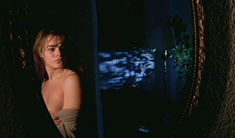
Those who dismiss Franco as an untalented hack will find most of their arguments confirmed here, as Tender Flesh wildly ignores such niceties as logic and polished camerawork. The dialogue (recorded on the set in English) is unintelligible for much of the running time, the acting is atrocious (apart from the always fascinating Ms. Romay of course), no two characters have the same accent, and the story is virtually nonexistent. On the other hand, as with many Franco films, half the fun lies in tracing the evolution of his favorite characters and storylines. The second half is basically an updated remake of Franco's excellent The Perverse Countess (which really needs to be released in the U.S., pronto), while the tropical island fun and games are pulled straight from Macumba Sexual and Eugenie (the '81 version). And of course, the nightclub opener is a direct descendent of Succubus and Vampyros Lesbos. Silicone doll Newman doesn't make for a very compelling leading lady on a par with Franco's past starlets, at least until one considers that she isn't really supposed to be an admirable or even interesting character in the first place. Tender Flesh can be tough going for the uninitiated, but Franco-philes will no doubt eat it up.

Seduction Cinema's DVD looks only a slight step up from the previous VHS release, and for the record, yes, the infamous kitchen urination scene is back in all its uncut glory. The mild letterboxing looks about right, and apart from the muddy, noise-ridden opening five minutes, colors and detail levels are satisfying. The surround audio shows off Franco's catchy jazz score quite well and uses the rear channels fairly often, creating a sultry listening environment spoiled only by the aforementioned poorly recorded dialogue. Side B of the DVD contains several extras, the most notable being the 51 minute Making of Tender Flesh documentary. This shot on video peek behind the scenes contains random footage of Franco running amok with his camera, interspersed with interview footage (primarily Petit). The surprisingly poor image quality of the occasional film clips used here will make any viewer grateful for the DVD presentation. Also included is a six minute look at Amber Newman's photo shoot for the film's (very Redemption-like) promotional artwork, as well as a slew of trailers for Seduction Cinema's DVD releases. This may not be the best Franco film by a long shot, but the presentation and extras should find favor with any unrepentant Eurosleaze collector.


Mondo Digital ReviewsMondo Digital LinksFrequently Asked Questions