
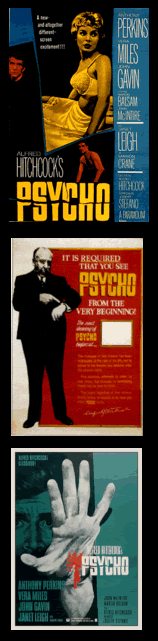
Following his less than warmly received 1939 adaptation of Daphne Du Maurier’s Jamaica Inn, Alfred Hitchcock surprisingly chose another of the esteemed mystery writer’s novels for his first American project under the supervision of David O. Selznick. The result, of course, became one of the Master of Suspense’s most enduring and popular creations, though it’s rarely cited as a good representative of his style. Perhaps the “woman’s picture” stigma associated with this genre has prevented this film from the historical recognition of Psycho or Rear Window, but in terms of both storytelling and technical craftsmanship, Rebecca can scarcely be faulted and has aged as magnificently as any Hollywood product. PSYCHO B&W, 1960, 108 mins. Directed by Alfred Hitchcock
Starring Anthony Perkins, Vera Miles, John Gavin, Janet Leigh, Martin Balsam, John McIntire, Simon Oakland, Patricia Hitchcock / Music by Bernard Herrmann / Cinematography by Robert Burks
Letterboxed (1.85:1) / Dolby Digital Mono
VERTIGO Color, 1958, 128 mins. Directed by Alfred Hitchcock
Starring James Stewart, Kim Novak, Barbara Bel Geddes, Tom Helmore, Henry Jones / Music by Bernard Herrmann / Written by Samuel A. Taylor & Alec Coppel / Cinematography by Robert Burks
Letterboxed (1.85:1) / Dolby Digital 5.1
ALFRED HITCHCOCK PRESENTS B&W, 1955-59, 102 mins. Directed by Alfred Hitchcock
Format: DVD - (MSRP $74.98)
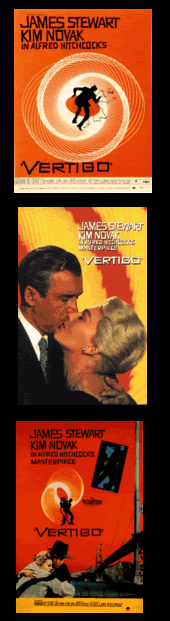
The restoration of Hitchcock's Vertigo has already been covered exhaustively, even with an entire book devoted to the subject, but simply put, the film has never looked better than it does here. The eye-popping hues and exquisite cinematography easily shame the earlier MCA laserdisc, though a few quibbles can justifiably be made with the tampered "restored" soundtrack which amplifies new sound effects like crumpling paper and footsteps to a distracting degree. On the other hand, Herrmann's score sounds terrific blasting from every available speaker instead of the old mono mix, and the plentiful extras cover everything you could want to know about the film. The entertaining and informative restoration documentary (commissioned for AMC) features several interviews and behind the scenes nuggets of information which are carried through to the other supplements, including stills, ad art, and the notorious alternate ending which was mercifully left on the floor over the years. So does the film itself merit all this attention? Absolutely. A fetishistic masterpiece, Vertigo concerns "Scotty" Ferguson (James Stewart), a police detective whose involvement in the death of a fellow officer has left him cursed with an acute fear of heights. An old college chum, Gavin Elster (Tom Helmore), hires Scotty to follow Elster's wife, Madeleine (Kim Novak, never better), who may be possessed from beyond the grave by a distant relative. To reveal more, of course, would be heresy. Steeped in the obsessions which flicker through the rest of Hitchcock's work, Vertigo remains an achingly personal statement on the human instinct to reshape others into our own fabricated images and the consuming nature of passion even beyond death. Stewart, brilliantly cast against type, delivers a gutsy, terrifying performance unlike anything else he ever attempted. The film's relative failure at the box office at the time is understandable, as the film is about as anti-'50s as one can imagine, but its acceptance now in more jaded, self-analytical times seems highly appropriate. A film completely steeped in its own iconography, Psycho forever changed the face of American horror and has become such a familiar part of our cinematic language that it rarely scares anyone now. The radical techniques on display here from the first frame to the last (Hitch often insisted it was a comedy!) actually seem quaint now, but even without the shriek value it once possessed, Psycho remains a crucial film - not as personal as Vertigo by any means nor as gloriously entertaining as Rear Window, but an icy, perfect jewel nonetheless. Universal's new transfer of Psycho is generally first rate, marred only by overmatting (according to the hard matte always visible in the shower scene, it should be around 1.66:1). This glitch aside, Psycho looks quite sharp and clean, while Herrmann's "black and white" string score sounds robust and absolutely chilling. Anthony Perkins' portrayal of Norman Bates, the mother's boy motel owner who encounters fleeing embezzler Marion Crane (Janet Leigh), remains one of the cinema's definitive performances (just check out Gus Van Sant's disastrous color remake to see how difficult this role is to pull off). So many scenes have become classic: the parlor talk between Marion and Norman, the shower sequences, the ascent (and descent) of Detective Arbogast (Martin Balsam) on the Bates stairs, and of course, the utterly creepy subliminal final shot. The DVD also sports a number of extras including an exhaustive one hour documentary (though the "censored scene" bonus is a bit of a joke), trailers, and assorted production notes and tidbits. Given the treatment of these two films, the future for Hitchcock at Universal looks quite promising.
The set's trump card, Alfred Hitchcock Presents, contains polished new transfers of four episodes widely available on video through the years. The most popular, "Lamb to the Slaughter," features Barbara Bel Geddes as a snubbed wife whose crime of passion requires some quick thinking around the investigating police. In "The Case of Mr. Pelham," the title character discovers he has a doppelganger tampering with his life, a development which drives him to unexpected extremes. In "Banquo's Chair," the title reference to Macbeth takes shape when a dinner is set to unmask a murderer by having his "victim" show up at the table. Finally, "Back for Christmas," another morbidly witty piece, features John Williams (Dial M for Murder) as a man digging his wife's grave -- err, a wine cellar -- whose plan may be too perfect to go along without a hitch. All of these episodes represent the series well, though many more are equally deserving (some of the Cornell Woolrich adaptations in particular). With any luck Universal will try to preserve a few more of these and not be content to simply reissue prepackaged catalog titles, though admittedly the results here are much better than the old video versions. Black and white TV productions have rarely looked so beguiling, and Universal's preservation efforts so far on television series like Thriller, Night Gallery, and this one are definitley to be commended.
Directed by Alfred Hitchcock
Starring Ingrid Bergman, Gregory Peck, Leo G. CarrolL
MGM (Blu-Ray & DVD) (US R0 HD/NTSC), Anchor Bay, Criterion (US R1 NTSC), PT Video (UK R2 PAL)
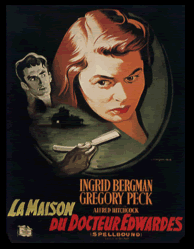 Even more than most Alfred Hitchcock films, the 1945 psychological thriller Spellbound seems like pure glossy entertainment on the surface but becomes increasingly weird under closer scrutiny. Loosely derived from Francis Beeding’s novel The House of Doctor Edwardes, the film assumes (rather implausibly now) that all of Sigmund Freud’s theories of psychoanalysis were absolutely correct and could unlock any key to the human mind. Hitchcock’s treatment adopts these Freudian techniques to a twisty murder plot, but more intriguingly for film buffs, he also throws in some nifty visual gimmicks indicative of what he would later achieve in his more extreme work beginning with Vertigo.
Dr. Constance Peterson (Bergman, looking quite lovely but studious) has earned the respect of her peers despite her status as a woman in a profession dominated by males. To paraphrase one of her colleagues, women generally make the best psychoanalysts until they get married, at which point they make the best patients. Her life carries on normally at an institute in Vermont until she encounters John Ballantine (a boyish Peck), a disturbed young man suffering from amnesia. Constance is intrigued by his case, particularly when he reveals an aversion to parallel lines on white surfaces. Evidence begins to surface that Ballantine may have been involved with the mysterious ski slope death of Dr. Edwardes, the former head of the institute, but Constance believes that John is innocent and possesses the key to the mystery inside his tortured mind. The two become lovers and go on the run, though Constance realizes her new beau might not be too trustworthy, especially when he’s prone to walking around at night with a straight razor in his hand. Of course, nothing is as it seems, and after much tortuous mental probing, Constance finally discovers the true sequence of events that led to the doctor’s violent death.
Of all the Hitchcock films, Spellbound contains perhaps the greatest potential to make a truly spectacular special edition on home video. Aside from the obvious sociological and psychological aspects that could be explored, the film also boasts a memorable dream sequence designed by none other than the master of surrealist art, Salvador Dali. Though striking in its current form, this sequence originally ran about twenty minutes and, according to Bergman, features a sequence in which she turns to stone, is cracked open, and finds herself covered in swarming ants. Whether any of this footage still exists is anyone’s guess, but a visual study of this sequence would be very welcome. Furthermore, the film contains the genesis for numerous ideas explored in other Hitchcock films, particularly the concept of past traumas burying themselves in someone’s subconscious and emerging in radically different forms (see Marnie for a fuller extension of this idea).
Anchor Bay’s DVD presents the film with no extras at all, as with the other ABC-licensed titles. The transfer by and large improves tremendously on the soft, washed-out laserdisc released by Fox but drops the ball on one nifty Hitchcockian touch which has remained intact in all other video editions and most TV airings; not to give too much away, but during the climax when the gun is pointed at the screen and fires, the black and white film contains two red-tinted frames at the moment of the bullet’s explosion. Though subliminal, it’s a nice effect; too bad the folks who prepared this DVD didn’t do their homework.
The PT Video edition in the UK contains a number of Hitchcockian extras which also appear on their discs of Rebecca and Notorious. The Criterion edition corrects the red tinting at the end of the film, reinstates the entrance and exit music, and features an improved digital transfer, but it was swiftly discontinued. Extras on that two-disc set included commentary by critic Marian Keane, an extensive essay on the Salvador Dali dream sequence, excerpts from a 1973 Miklos Rozsa radio interview, the 1948 Lux Radio Theatre performance with Joseph Cotten and Alida Valli, a radio lesson on the Theramin, Hitchcock scholarly essays, extensive galleries, and the theatrical trailer. The MGM version, including a still soft but passable HD transfer unlikely to win over many home theataer buffs, features an audio commentary with film writers Thomas Schatz and Charles Ramirez Berg, a “Running with Scissors” 21-minute video look at Dali’s involvement, a “Guilt by Association” 19-minute dissection of the film’s then-novel use of psychoanalysis in film, a 10-minute video bio of costar Rhonda Fleming, the radio version, yet another Bogdanovich/Hitchcock interview, and the trailer. A grand but bizarre and sometimes silly entertainment with some dubious psychosexual subtext thrown in for good measure.
Directed by Alfred Hitchcock
Starring Joan Fontaine, Laurence Olivier, George Sanders, Judith Anderson, Gladys Cooper, Nigel Bruce
MGM (Blu-Ray & DVD) (US RA/R1 HD/NTSC), Criterion, Anchor Bay (US R1 NTSC), PT Video (UK R2 PAL)
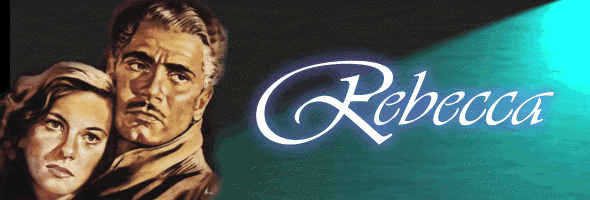
A young woman (Fontaine), whose name is never given, meets the brooding, attractive, and wealthy Maxim De Winter (Olivier) while serving as a paid companion on the Riviera. Much to her employer’s disapproval, our heroine takes off with Maxim and becomes his second wife; apparently, the first Mrs. De Winter, Rebecca, died in a mysterious boating accident. Upon her arrival at Manderley, the De Winter home, the second Mrs. De Winter receives a cool reception from the main housekeeper, Mrs. Danvers (Anderson, walking off with the film in her pocket). Apparently Mrs. Danvers had more than a slight obsession with Rebecca and takes every opportunity to remind the new wife of her inferiority in every possible respect. However, a few less than pleasant skeletons in the closet begin to emerge, and the newlyweds find their happiness and even their lives in jeopardy as the ghosts of the past begin to return with a vengeance.
Beginning as nervous and submissive but gaining confidence as the dark events begin to unfurl, Fontaine’s performance provides the emotional anchor for what could have been a routine Gothic potboiler. Everyone involved lifts this tale to the highest notch of slick professionalism, ranging from Franz Waxman’s beautiful, eerie score to Hitchcock’s subtle manipulation of spatial relationships and décor details (note Rebecca’s embroidering). Though Rebecca is naturally deceased before the film even begins, her presence consumes the entire film and channels through the unforgettable Mrs. Danvers, leading to the memorable and often imitated fiery climax. While Olivier does a fine job doing a rich twist on his tragic hero persona from Wuthering Heights and George Sanders provides his usual sardonic and nasty wit, the women both seen and unseen definitely carry this film, establishing most of the central conflicts along the way.
Criterion’s transfer of Rebecca in its two-disc DVD incarnation corrected most of the damage done to this gem over the years, with most of the image meticulously restored and featuring a more robust contrast scale than even the lovely Anchor Bay DVD. The sound has also been noticeably cleaned up, with the opening musical strains freed from background noise and hiss. The Criterion version (which features overly severe windowboxed credits) retains all of the laserdisc extras, including hosts of auditions, interviews, costume drawings, test footage, and voluminous text studies. The UK disc features the restored transfer with the same Hitchcock-related extras as their release of Notorious. The film looks even silkier in its Blu-Ray incarnation, which also includes a Richard Schickel commentary, isolated M&E track, a 28-minute making-of featurette, a “Gothic World of Daphne DuMaurier” overview, screen tests, the radio plays, Hitch interviews with François Truffaut and Peter Bogdanovich, and the trailer. Note: Rebecca was Hitchcock’s only Best Picture Academy Award winner, though at the time only the producer received the award. Thus, Hitch would have to wait until his honorary Irving G. Thalberg award before he could have a statuette of his own.
Part of the growing (but so far hit and miss) box set trend in
 the DVD market, Universal's The Alfred Hitchcock Collection immediatley disappointed many consumers who found out that it simply contained repackaged editions of two films already on DVD, Psycho and Vertigo, in addition to a four-episode platter of Alfred Hitchcock Presents, available exclusively in this edition. Quite simply, at this price tag, anyone who doesn't have the two films would be well advised to pick this one up, while Hitch fanatics who already have the films will find this far too steep to buy simply for four episodes already released before on laserdisc and VHS. The packaging is better than Warner's Kubrick box set but still inconsistent, with the TV episodes packaged in a plain silver design that clashes with the more gaudy and gold-striped format of the other two discs. Hopefully Universal will take another stab at a Hitchcock collection once they have remastered more of the Master's films in their possession (where's The Birds, guys?), and then fans will really have cause to celebrate.
 A magnificent film, definitely worthy of the multiple viewings and intense study it has finally received in recent years.
