
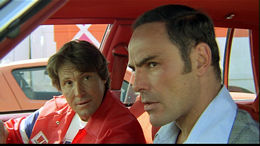
Color, 1979, 91m.
Directed by David Cronenberg
Starring William Smith, Claudia Jennings, John Saxon, Nicholas Campbell
Blue Underground (DVD & Blu-Ray, US R0 NTSC/HD) / WS (1.85:1) (16:9) / DD5.1/DTS 7.1

Years before he melded his body grotesqueries with car collisions in the controversial Crash, director David Cronenberg helmed this more straightforward ode to one of his more obscure passions, competitive auto racing. Another tax shelter Canadian project incredibly made back-to-back with the equally personal but far more harrowing The Brood, this film offers straight-up drive-in entertainment with a solid cast of B-movie legends.
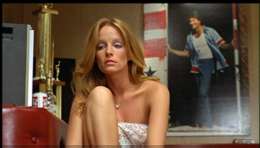
Facing the end of his run on the dragstrip due to approaching middle age, racer Lonnie Johnson (Grave of the Vampire’s Smith), dubbed “Lucky Man” by his fans, is about to lose the sponsorship of the motor oil company with which he’s become identified under the rule of a hard-nosed CEO (Saxon). Aided by his beautiful younger girlfriend, Sammy (Jennings), he tries to come up with a way to keep up with the accelerating demands of his dangerous profession.

At first you’d be hard pressed to peg this as a Cronenberg film, though the presence of regular collaborators like actor Nicholas Campbell and cinematographer Mark Irwin give it this uniquely ‘70s Canadian feel also found in his more fantastic projects. You also get an attention-getting scene involving the erotic use of motor oil, which is difficult to forget. However, the actor chemistry is the biggest difference here mainly due to the presence of Saxon, an industry vet from films like Enter the Dragon and Black Christmas, who really anchors his scenes with great authority. Perhaps even more significant is Jennings, a hugely popular Playboy Playmate whose film career had already amassed such credits as ‘Gator Bait, Deathsport, Moonshine County Express, and even a quick bit in The Man Who Fell to Earth; unfortunately Fast Company would prove to be her cinematic swan song as she died in a car accident shortly after filming at the age of 29.

Blue Underground’s elaborate special edition of this film puts many studio efforts for the director’s more presitigious titles to shame with an impressive transfer and a comprehensive roster of extras. Mastered in HD, the film looks terrific and sounds even better with an immersive surround mix. (The original mono is present on the DVD while the Blu-Ray ditches it in favor of three similar 7.1 options in Dolby Digital or DTS.) Cronenberg contributs another of his excellent solo commentary tracks and shares many memories of Canadian filmmaking at the time and how his passion for racing fueled the entire project. Then Smith and Saxon appear for an interview featurette in which they recall how they become involved with the film and the state of their careers at the time, with both coming off as animated and full of enthusiasm. Irwin gets a separate interview discussing his relationship with the director and how they approach the visual scheme for each of their films, and you also get the original theatrical trailer.

Both the double-disc limited DVD edition and regular Blu-Ray offer the heftiest and more desireable extras: Cronenberg’s two most famous early “short” films, Stereo (1969) and Crimes of the Future (1970), both of which are virtually feature length. The former is an obvious dry run for ideas later explored in Scanners and The Brood as a psychology researcher at a cinic uses brain surgery to cut off verbal communication from a group of volunteers, but the study begins to go awry as the psychological ramifications begin to manifest themselves. Crimes is far less accessible and definitely feels more like an early trial project as a skin doctor named Adrian Tripod (Cronenberg regular Ronald Mlodzik) in a clinical, emotionless future begins to tamper a contagious version of sexual hysteria, ultimately blurring the lines of gender identity. Both are highly visionary and fascinating films, especially for Cronenberg fans, and are worth the effort to find this release by themselves.


Color, 1991, 115m.
Directed by David Cronenberg
Starring Peter Weller, Judy Davis, Julian Sands
Criterion (US R1 NTSC) / WS (1.78:1) (16:9) / DD2.0, Video/Film Express (Holland R2 PAL) / WS (1.85:1) / DD5.1, GCHTV (France R2 PAL), Asmik (Denmark R2 PAL, Japan R2 NTSC) / WS (1.78:1) (16:9) / DD5.1


When he first adapted another writer's work in 1983, Stephen King's The Dead Zone, David Cronenberg was accused by more than a few baffled fans of watering down his distinctive vision in service of Hollywood conventions. However, few lobbied this claim against Cronenberg again when he tackled another book, William S. Burroughs' Naked Lunch, and produced one of the more baffling, incendiary studio films of the 1990s. A compatriot of such beat icons as Jack Kerouac and Allen Ginsberg, Burroughs earned some degree of notoriety by shooting his wife in the head during a William Tell-inspired stunt, only to become a counterculture icon until his death in 1997. Since his explicit, free-associative Naked Lunch resists adaptation in the traditional sense, Cronenberg solved the problem by integrating elements of the novel into Burroughs' life and other writings, producing a work representative of both men's philosophies.

Exterminator and former addict Bill Lee (Weller) lives with his not-always-faithful wife, Joan (Davis), who has a nasty jones for the bug powder her husband uses on the job. Equipped with breath capable of felling cockroaches on the spot, she draws Bill back into a world of addiction and squalor which climaxes with the aforementioned bullet accidentally fired into her head. As Bill's dependence on the bug powder increases, his ability to discern between reality and illusion crumbles. His typewriter becomes a twitching, metallic insect, and he receives information from visiting roach-like beings who lure him into the Interzone, a Middle Eastern realm populated by such odd characters as icy Tom Frost (Ian Holm) and the peculiar Yves Cloquet (Julian Sands), who has a penchant for young men. Bill's chemical dependence is further aided by the smiling but shifty Dr. Benway (Roy Scheider), whose role in the Interzone may be more significant than Bill initially realizes.

Initially received with a mixture of confusion and condescension, this challenging, uncompromising film's reputation has grown considerably over the past decade or so thanks to Cronenberg's growing filmography, which places it in a much firmer context. Followed by the likes of Crash and eXistenZ, this is the obvious blueprint for the next phase in the director's career following the mainstream humanist trilogy of The Dead Zone, The Fly, and Dead Ringers. Here the abrasive relationship between flesh and metal, soul and technology, becomes much more symbiotic, offering a complex and sensual depiction of modern evolution (hinted at in the rejected ending of Videodrome but only developed here years later). For Cronenberg newcomers, this film is hardly the place to start; it's a deliberately difficult, off-putting film on first viewing, with multiple layers of meaning depending on one's perspective; it's a story of artistic inspiration, battling with personal demons, succumbing to the alluring addictions which plague everyday life, and of course, very strange creatures engaging in grotesque behavior. As usual Howard Shore accentuates the visuals with a sly, intricate jazz score, memorably introduced during the stylish opening credits. The actors are all top notch, with seasoned pros Davis and Holm walking off with all of their scenes; Weller has the more difficult task of playing a Burroughs surrogate while remaining a solid identification figure throughout the film, and his ability to convey yearning, confusion, and despair with a simple glance serves Cronenberg well.

Though Naked Lunch is one of Cronenberg's more visually rich achievements, most of Fox's sparsely distributed prints were poorly struck and failed to convey much of the burnished color schemes. All of the DVDs offer a more solid viewing option, with the Criterion and pricier Japanese discs the best of the lot thanks to a sterling anamorphic presentation. The Criterion disc features the original surround audio, while the Japanese and Dutch editions have a retooled, shaky 5.1 mix with fake split surround effects. As far as extras, completists may want all of the available variants, but the Criterion double-disc set contains the most thorough and financially sensible alternative. Cronenberg and Weller appear for an excellent commentary track, which covers the various stylistic choices, the sources used for the screenplay (including Burroughs' "Exterminator"), a solid rebuttal to common criticism about Cronenberg's treatment of Burroughs' homosexuality, and extensive discussion of the symbolism used throughout the protagonist's journey. All of the extras are confined to the second disc, whose major coup is the South Bank Show special, "Naked Making Lunch." Featuring on-location footage and interviews with all of the principals, this 48-minute chronicle is essential viewing for Croneberg fans and considerable insight into the elaborate process of bringing Burroughs to the screen. Other goodies include an annex of promotional material including the striking theatrical trailer (featuring a Burroughs sound-alike as narrator), an illustrated essay about the special effects by Jody Duncan, a stills gallery, excerpts of Burroughs reading the original source novel, a black and white gallery of Burroughs photos from various points in his life, and a booklet featuring observations from Janet Maslin, Chris Rodley, Gary Indiana, and a piece by Burroughs himself. The more slimmed-down Japanese and French discs feature a Cronenberg commentary, the TV special, and trailer (with the better-looking French set spread over two platters); while the other European discs include only the trailer and an 8-minute video interview with Cronenberg.


Color, 1999, 98m. / Directed by David Cronenberg / Starring Jennifer Jason Leigh, Jude Law / Alliance (Canada R1 NTSC), Buena Vista (US R1 NTSC), Momentum (UK R2 PAL) / WS (1.78:1) (16:9) / DD5.1


David Cronenberg's most viewer-friendly film since The Fly tackles the potentially trite subject of virtual reality in his usual off-kilter, probing style. Featuring one of his strongest casts and his usual behind-the-scenes conspirators at the top of their form, eXistenZ makes for both a relatively safe introduction for newcomers and a kicky diversion for fans of his similar Videodrome. During a sneak testing session for her newest game, eXistenZ, virtual design goddess Allegra Geller (Jennifer Jason Leigh) falls victim to an assassination attempt which goes awry. Protected by her company's jittery public relations agent, Ted Pikul (Jude Law), she flees to the countryside where the two enter her game to uncover the dark secrets behind the assassination plot. As the film shifts in and out of reality and the virtual scenario, the two become increasingly confused about their own surroundings and identities.

Anchored by the two solid lead performances, Cronenberg's quirky chamber piece deliberately toys with viewers' expectations right from the beginning. The expected hi-tech hardware is replaced by flesh game pods and umbilical connections into players' spines, while blatantly phony and arch performances are exposed to be precisely that. The twisty narrative constantly threatens to veer into incoherence but always stops short to reveal one more jolting surprise, and the director's often overlooked sense of humour is well in evidence here. Leigh provides one of her most fetching performances and has never looked better, while Law skillfully adapts to the transformative needs of his role to prove his standing as one of the new acting generation's most promising talents. The excellent Sarah Polley and Christopher Eccleston are virtually tossed away in small parts, but Ian Holm, Willem DaFoe, and the rest of the crew have juicier parts to tackle. As usual, Howard Shore's moody, experimental score nails each scene perfectly, while Peter Suschitzky manages to equal the evocative cinematic imagery he conjured up in Crash. First released in a basic US DVD edition from Buena Vista with only the US trailer as a bonus, eXistenZ has been given a much more elaborate treatment in its Canadian and English variations from Alliance and Momentum, respectively. The anamorphically enhanced transfers of all the discs look very similar, with the non-U.S. versions boasting a slightly less "digitally filtered" look. The special editions feature no less than three running commentaries; Cronenberg provides the first and most entertaining, which points out a number of small touches which would escape the casual viewer. Suschitzky and special effects supervisor Jim Isaac discuss their own involvement on separate tracks and essentially provide every scrap of technical information imaginable about the film, augmented with a few nifty references to Cronenberg's past work. "The Invisible Art of Carol Spier," a 53 minute documentary dedicated to the film's production designer (and a Cronenberg regular), features behind-the-scenes footage and interviews covering her diverse career, with a special emphasis on eXistenZ. The Canadian trailer strongly resembles the one designed by Miramax, with a techno-music finale, but the alternate French-language Candian trailer also included on the Alliance disc features completely different editing and music cues lifted from Scream.


Color, 1977, 91m. / Directed by David Cronenberg / Starring Marilyn Chambers, Frank Moore / Metrodome (UK R2 PAL) / WS (1.85:1) (16:9) / New Concorde (US R1 NTSC)


Following the success and controversy ignited by Shivers, David Cronenberg expanded his view of clinical, sexualized horror with Rabid, a chilly account of venereal disease gone absolutely haywire through Montreal. Most notable in the history books as the first attempt by hardcore actress Marilyn Chambers (Behind the Green Door) to go straight, the film has gained considerably in both meaning and chilling effectiveness in context with Cronenberg's later films. A devastating motorcycle accident in the countryside leaves beautiful young Rose (Chambers) seriously burned and mutilated while her boyfriend, Hart (Frank Moore), is thrown clear. Luckily employees at the nearby Keloid Clinic witness the accident and, using innovative new techniques in plastic surgery and tissue regeneration, manage to save Rose from certain death (or at least horrible disfigurement). Dr Keloid (Howard Ryshpan) and his partner, Murray Cypher (Joe Silver), feel their procedure has been successful, so Rose is left alone to recover. A month later she regains consciousness in a state of utter hysteria, causing one of her fellow patients to come to her aid. She embraces him tightly, an act which causes him to react with horror. Later the patient, bloody and dazed, staggers down the hospital hallways, but no one is able to treat him. One by one Rose seduces and attacks others in the hospital, draining them of just enough blood to satisfy her hunger. Keloid discovers a strange, vaginal growth in her armpit which hosts a horrendous side effect of her skin graft, one which is also capable of leaving its victims in a dangerous, rabid condition capable of spreading through the population like wildfire.

Though undeniably rough around the edges, Rabid is a strangely potent and haunting film. Chambers is surprisingly good in the role, which doesn't require much range but definitely exploits the mixture of pleasure and dangerous hunger lurking beneath her attractive features. As usual Cronenberg maximizes the chilly potential out of his sterile, angular settings and barren countrysides, while the city locales are cleverly manipulated to expose the dangerous underbelly of urban life. Chambers' visit to a porn theatre in particular and subsequent response to a horny fellow patron is a disturbing, multilayered example of Cronenberg at his finest. The uncredited stock music is also eerily spare and well chosen, though it wasn't until Croneberg's next horror film, The Brood, that music finally took center stage thanks to Howard Shore. As usual the director also relishes throwing in some iconoclastic and often downright rude imagery, such as a shopping mall Santa Claus riddled with bullets and the grim, marvelously ironic coda, which relays most of its horror through the telephone rather than explicit gore. Long unavailable on home video after an early, substandard appearance from Warner Home Video, Rabid has been remastered by Roger Corman's New Concorde. Like their other '70s restorations, this film has never looked so good outside of first run theatres. However, bear in mind that some sequences were shot in a deliberately desaturated and grainy style, while the opening credits were printed with dirt and specks imbedded in the script overlays, so the visual flaws are actually supposed to be there. Like all of Cronenberg's early films, Rabid was shot full frame and soft matted in theatres; the US DVD contains the entire exposed image with (clumsily transitioned) 1.66:1 closing credits, though letterbox purists with 16:9 sets can matte it off if they so desire. The UK disc features an improved and colorful anamorphic transfer which mattes off some information from the top; the increase in resolution is noticeable and quite welcome. The mono audio is adequate given the source materials and is free from distracting background noise or distortion. The US disc also includes the gleefully dramatic US theatrical trailer, while the UK disc instead contains a Cronenberg intro, notes by Kim Newman, and an image gallery.


Color, 1997, 111m. / Directed by David Cronenberg / Starring James Spader, Holly Hunter / New Line (US R1 NTSC), Columbia (UK R2 PAL) / WS (1.78:1) (16:9) / DD2.0


Maligned by Ted Turner, ignored by American audiences, and a general offense to many of the attendees at Cannes, David Cronenberg's Crash has been so overshadowed by the political and critical turmoil surrounding it that the actual film's voice has been drowned out in the process. If you like Cronenberg, you'll love the film, which is a quantum leap in maturity and quality over the flat M. Butterfly. While the sight of James Spader sexually assailing a gash in Rosanna Arquette's leg may not appeal to every sensibility, this is a challenging and often rewarding ride if you're willing to go along with the filmmaker's own unique, marvelously depraved point of view. Based on J.G. Ballard's scandalous counterculture novel, Crash revolves around James Ballard (Spader), a director who suffers a near-fatal car crash when he collides with doctor Holly Hunter. The two find themselves aroused by the experience, and she introduces Ballard to a bizarre subculture dedicated to reenactments of famous celebrity car crashes (Jayne Mansfield, James Dean, etc.). The group's leader, Vaughn (the always fascinating Elias Koteas), orchestrates a series of fleshy auto escapades involving his protegee, Rosanna Arquette, and Ballard's spacey, erotically insatiable wife (Debroah Kara Unger, The Game). One of the film's most notorious scenes, a mild sex scene between Spader and Koteas, was primarily responsible for driving audience members away, but there's much stronger stuff on display. The eerie, unresolved finale ("Maybe the next one") amazingly manages to wrap up the dreamlike proceedings on a satisfying note that will leave a strange mood hovering in your mind long after the film is over.

While no video presentation can really replicate experiencing Crash in the theatre (after which audience members had to drive home), DVD is about as close as you can get. Though supervised by Cronenberg, the Criterion Collection laserdisc was a visual mess, smeary and dull, with poor detail. The anamorphically enhanced DVD is a feast for the eyes, filled with glittering planes of glass and metal and suffused with unearthly shades of blue and silver. There's simply no comparison. The US DVD also has the option of playing the film's R-rated cut, which causes momentary pauses in the film's playback as it skips over the most graphic bits. Aside from basic curiosity, however, it's hard to imagine why anyone would want to see this watered-down Blockbusterized edition. Likewise, the Dolby Digital soundtrack is expansive and chilling, with Howard Shore's unnerving experimental score swelling from each speaker and drowning the ears in uneasiness and lust. Unfortunately, aside from the US trailer, the DVD features none of the Criterion bonuses (feature length commentary by Cronenberg, the original and superior Canadian trailer, and a making-of featurette), so completists will unfortunately want to get both. If you just care about the movie, though, the DVD is definitely the best (and most affordable) way to go.


Color, 1979, 92m. / Directed by David Cronenberg / Starring Oliver Reed, Samantha Eggar / MGM (US R1 NTSC), Opening Distribution (France R2 PAL) / WS (1.85:1) (16:9), Arrow (UK R2 PAL)


[REVIEW DOWN FOR MAINTENANCE - RETURNING SHORTLY!]

Color, 1975, 87m. / Directed by David Cronenberg / Starring Paul Hampton, Lynn Lowry / Metrodome (UK R2 PAL) / WS (1.85:1) (16:9), Image (US R0 NTSC)


David Cronenberg's first film, better known to US viewers as They Came from Within, is one of those little gems in which a director's first feature already displays his major themes and concerns, similar in many ways to Romero's Night of the Living Dead. A similarly revisionist look at society pulled inside out by modern technology, Cronenberg ups the ante by throwing the era's cavalier attitude towards sexuality into the mix. Thus, in this film, the residents of a technologically advanced hi-rise are transformed into decadent, violent mirrors of their former selves by fecalesque parasites which invade the body through sexual (mostly oral) contact. Not exactly pleasant stuff, but Cronenberg's chilly, piercing style makes this impossible to turn away from, regardless of how you may feel about it. Cult film fans will also enjoy the presence of Italian horror diva Barbara Steele in one of her most perverse roles, as well as a memorable part by underrated exploitation starlet Lynn Lowry (Score, I Drink Your Blood, Sugar Cookies). This new "director's cut" really isn't anything new; most of the nasty footage which was previously censored from the US prints has been available to horror fans in various editions, including the CIC Canada videotape, an uncut release from Vestron video, various uncut British VHS releases and a Japanese laserdisc (released with Rabid and The Brood). However, the big news is the picture quality, which is a quantum leap over any previous edition. While the opening titles still look pretty washed out (and must have been filmed that way), the rest looks very clear and sharp, with startling bursts of color throughout. The film is presented full frame in a transfer that is either unmatted or very slightly cropped from 1.66:1; either way, it looks just fine. DVD-philes may be put off by the visual limitations of the low budget (a little grain here, an overdone exposure there), but horror buffs will be more than pleased. As a bonus, the DVD includes the original (and very creepy) Canadian trailer and an informative 20-minute interview with Cronenberg about his tax shelter days in Canada and the birth of his first feature film. The interesting liner notes (including a surprise tidbit about Jonathan Demme) make this package even more desirable. Note: the 110-minute running time on the box refers to the film and all of the supplements combined. The UK edition from Metrodome was released later and mattes off the image to 1.85:1, with anamorphic enhancement; it looks a bit tight overall and magnifies the grain in the image, but fans may find the increase in resolution worth it.

Mondo Digital Reviews Mondo Digital Links Frequently Asked Questions