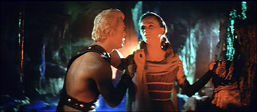
Color, 1965, 88 mins. / Directed by Mario Bava / Starring Barry Sullivan, Norma Bengell, Angel Aranda, Evi Marandi / MGM (US R1 NTSC) / WS (1.85:1), Legend (Germany R2 PAL), IIF (Italy R2 PAL) / WS (1.85:1) (16:9) An S.O.S. signal in space draws two ships to a seemingly uninhabited, mist enshrouded planet. For no apparent reason the crew members of one ship kill each other in a violent frenzy, while the second ship, the Argos, is saved by the will of the steadfast Captain Markary (Barry Sullivan). While the bodies of the dead are buried in transparent bags (and a few of the deceased vanish without a trace), the astronauts explore their new terrain and discover traces of past alien voyagers left to die on the planet. Furthermore, the dead crew members seem to be still roaming the dark, misty landscape, and the lines separating the living and the dead begin to blur. The invisible force which destroyed one ship now seems to be wreaking havoc across the planet, and Markary and his crew
Though consigned to the matinee crowd during its release, Planet of the Vampires (which really doesn't have any literal vampires at all) has enjoyed a steadily growing reputation both through the increased appreciation of its director and the frequently noted story parallels to 1979's Alien. However, the film also functions perfectly well on its own terms; the slow pacing allows each creepy visual to seemingly pop out of nowhere, and the images of resuscitated astronauts tearing the plastic away as they rise of the earth are not easily forgotten. As usual Bava floods the screen with unnatural, saturated colors, and the sincerity of its construction allows the viewer to easily overlook the typical '60s conventions of its sci-fi trappings. While Antonio Margheriti's space sagas like Wild, Wild Planet offer delightful, First available on video from HBO and Thorn/EMI, Planet of the Vampires featured a decent but cropped transfer with a passable new Kendall Schmidt electronic score. The same edition appeared on laserdisc through Orion and Image, doubled up with Curtis Harrington's endearingly bizarre Queen of Blood (which shares two similar alternate titles, Planet of Blood and Planet of Vampires, with those given to Bava's film). After vanishing for a few years, Planet went through the restoration process at MGM, where it has surfaced in a dramatically improved widescreen (but non-anamorphic) transfer. The ads claimed the film was shot in "Colorscope," though this seems to be just standard hard matting (around 1.78:1 to 1.85:1) like Bava's other titles from the same period. The original, more subdued theatrical score has been reinstated (though to be honest, it won't make a tremendous difference to casual viewers), but more importantly, the image now glows with a hellish luminous quality sorely missing from previous editions. The film runs about two minutes longer than the 86 minute HBO print, presumably confined to some more character exposition or footage of actors wandering through the mist. Hopefully some Bava fanatics out there can more accurately pinpoint where the restored footage has been placed, as it doesn't immediately stand out. The disc also includes the amusing U.S. theatrical trailer, which makes the film look like a particularly unhinged episode of Star Trek. While Bava fanatics would have probably appreciated a few more extras, there's no arguing with the low price for a disc that unquestionably delivers. The same elements were also used for a higher resolution German 16x9 DVd release as well as occasional high-definition TV screenings.
For a fascinating variant, fans may also want to hunt down the Italian DVD (as Terrore nello spazio), which retains Bava's original cut of the film in Italian with optional English or Italian subtitles. The opening and closing credits here play out completely over black with the creepy ambient score gurgling underneath, a far more foreboding approach than the rather clunky Christmas light credits of the English language cut. Several scenes reveal slightly different editing and bits of alternate/additional footage, while the Italian dialogue thankfully eliminates the unintentional chuckles generated by the iffy English dub track. Picture quality is absolutely stunning, with pin-sharp detail and perfect colors. Don't expect much in the way of extras, though; all you get is a photo gallery and a look at the "2005 Venice Cult Film Festival."
The same company, IIF (Italian Inernational [sic] Film), has also released a welcome English-subtitled version of Bava's Dr. Goldfoot and the Girl Bombs (under its original title, Le spie vengono dal semifreddo). Notoriously mangled by AIP in its English language incarnation (with the usual Les Baxter score commissioned to replace the original by Lalo Gorri), the film fares somewhat better in Italian. Bava's visual panache is noticeably pulled back here, though the boffo opening credits and a few nice flourishes here and there in the production design reveal the hand of the master who went on to Danger: Diabolik. Comedic leads Franco & Ciccio aren't very amusing no matter what language they're speaking, but the experience of co-stars Vincent Price and Fabian yakking in Italian certainly has its curiosity value. Anamorphic picture quality is excellent overall (though a handful of shots appear to be taken from a blearier print).
Color, 1961, 82 mins. / Directed by Mario Bava / Starring Reg Park, Christopher Lee, Leonora Ruffo, George Ardisson / Music by Armando Trovajoli / Produced by Achille Piazzi / Fantoma (US R1 NTSC) / WS (2.35:1) (16:9)
After performing labors abroad, Hercules (Reg Park) is reunited with his best friend, the lothario Theseus (George Ardisson). Unfortunately Hercules' true love, Deianira (Leonora Ruffo), has passed into a strange trance and no longer recognizes the world around her. The shifty King Lico (Lee) advises Hercules to seek help from an oracle, who reveals that the only cure for Deianira lies in the underworld, specifically the powerful golden Apple of the Hesperides which provides access to the coveted Stone of Forgetfulness. Along with the bumbling Telemachus, Hercules (who has relinquished his immortality) and Theseus set off to the other side where they encounter a land of eternal night, filled with rock monsters, bubbling pools of lava, and deadly flying bloodsuckers. However, the greatest threat is yet to come...
Generations of bad prints and worse PD videotapes have offered only a hint of the visual glories to be found in Bava's second film; the DVD offers the original scope framing (or at least most of it-- the precise aspect ratio has been the subject of guesswork for years) as well as a wonderfully saturated color presentation which puts this up there with the finest of the Bava home video releases available. As with other European films of this vintage, the film stock betrays some signs of graininess and instability at times, but this is miles ahead of how the film has looked on television before. The disc also includes some nicely conversational liner notes by Tim Lucas (who pulls out some wonderfully odd trivia in the last paragraph), a ragged looking U.S. trailer, and an extensive photo and poster gallery. While Bava fanatics and fans of European horror will find this purchase a given, even those who avoid sword and sandal films should find this stellar entry more than worthwhile.
Color, 1970, 79 mins. / Directed by Mario Bava / Starring William Berger, Ira von Furstenberg, Edwige Fenech, Howard Ross, Helena Ronee / Music by Piero Umiliani / Cinematography by Antonio Rinaldi / Written by Mario Nardo / Image (US R0 NTSC) / WS (1.85:1) The breezy and meandering tone of Five Dolls can be a strange sensation at first, as the film bizarrely avoids graphic violence and instead presents each corpse as a tableaux discovered by the characters; whether sprawled on the beach, floating in a bathtub, or most memorably Color, 1966, 85 mins. Directed by Mario Bava Starring Giacomo Rossi Stuart, Erika Blanc, Fabienne Dali, Piero Lulli, Max Lawrence, Gianna Vivaldi / Music by Carlo Rustichelli / Cinematography by Antonio Rinaldi Format: DVD - VCI (MSRP $19.99) Full Frame / Dolby Digital Mono A young coroner named Dr. Eswai (or Eswe, depending on your source) (Giacomo Rossi-Stuart) arrives at a desolate Eastern European village and makes the acquaintance of the beautiful Monica (Erika Blanc), a medically trained native who has recently returned to her home. Together they perform an autopsy on a young maid who died under mysterious circumstances while employed at the eerie Villa Graps on the edge of town. The autopsy turns up a gold coin imbedded into the girl's Years before he exploded the conventions of spatial reality in Lisa and the Devil, Bava was already tampering quite daringly with cinematic storytelling in this film. The final half hour contains some magnificent sequences bound to disorient the hardiest viewer, including effective use of a seemingly endless spiralling staircase and a brilliant, Avengers-like conceit which finds the doctor trapped in endless circle within the same cluster of room. Fans of Euro starlets will also enjoy the presence of Blanc, who later steamed up drive-in screens as the star of The Devil's Nightmare. Regular Bava composer Carlo Rustichelli provides Though picked up by MGM for one of its many theatrical runs, Kill, Baby... Kill! (original title: Operaziona Paura, or Operation Fear) has remained one of the more difficult Bava horror titles to see in a form even close to its creator's intentions. A heavily truncated version entitled Curse of the Living Dead made the rounds as part of a notorious "Living Dead" triple bill in the late '60s, while the original version occasionally turned up on late night television and various public domain video labels. Relatively speaking, VCI's disc is the most watchable of the available options, thanks to the restoration of Bava's vibrant color schemes in which unnatural bursts of green, red, and blue accompany the characters' gradual descent into supernatural madness. Flesh tones look pale and dull, however, and the heavy graininess resulting from the 16mm makes the film look rougher and cheaper than it probably should. Also, the mild cropping from the original compositions (somewhere between 1.66:1 and 1.78:1) results in actors' faces scraping perilously close to the edge of frame. These debits aside, however, it's a great leap over the familiar Sinister Cinema version, for example, and should be enough to tide Bava fans over until a pristine widescreen version turns up somewhere. The disc also includes trailers for The Bird with the Crystal Plumage, Blood and Black Lace, and The Night Visitor, all accessible from a menu screen decorated in puzzling fashion with butcher knives. Color, 1963, 83 mins. Directed by Mario Bava Starring Dahlia Lavi, ChristopherLee, Tony Kendall, Gustavo De Nardo, Isli Oberon, Harriet White Medin /Written by Ernesto Gastaldi, Ugo Guerra and Luciano Martino / Music byCarlo Rustichelli / Cinematography by Ubaldo Terzano / Produced by ElioScardamaglia Format: DVD - VCI (MSRP$24.95) Letterboxed (1.85:1) / DolbyDigital Mono Cloistered in a seaside castle,the Menliff household is torn asunder by the return of black sheep sonKurt (Christopher Lee), a sadistic brute whose savage treatment of a localgirl forced him to be banished years earlier. Meanwhile his fiancee, Nevenka(Dahliah Lavi), has married his nice guy brother, Christian (Tony Kendall,a.k.a. Luciano Stella), and become unnaturally close with her father-in-law(Gustavo De Nardo). The housekeeper, Giorgia (Harriet White Medin), stillresents Kurt's treatment of her daughter, who committed suicide with anornate dagger now displayed in proper fetish fashion in a glass case. Angryover his father's continued denial to grant him status as an heir, Kurtencounters Nevenka on the beach and whips her furiously with a riding crop,an ordeal she accepts and apparently enjoys. Their love affair begins anew,but that Despite the potentiallysordid subject matter, The Whip and the Body treats its subjectwith a finely restrained, poetic edge. The whipping scenes are mild bytoday's standards, especially in the wake of Story of O, but Lavi'sfeverish expressions still convey a palpable sense of delirium, hunger,and confusion. Likewise, Lee is an imposing and memorable presence in arare appearance as a sexual predator and spirit, lurking in the shadowsand rising occasionally into Bava's unmistakable pools of hellish greenand blue lighting. Composer Carlo Rustichelli takes a break here from hisstandard lounge-oriented scores to provide an elegant, neo-classical scorein keeping with the off-kilter romanticism of the film, rising to an appropriatecrescendo during the memorable climax. Though not as overtly gruesome asother '60s horror titles, The Whip and the Body ultimately transcendsits genre to stand as a challenging work of art. Newcomers to Bava wouldbe advised to start elsewhere, but those already acquainted with the conventionsof Italian gothic should find this most impressive. Color, 1964, 90 mins. Directed by Mario Bava Starring Cameron Mitchell,Eva Bartok, Thomas Reiner, Ariana Gorini, Mary Arden, Franco Ressel, FrancescaUngaro, Claude Dantes, Harriet White, Lea Lander / Written by Marchello Fondato, MarioBava & Guiseppe Barilla / Music by Carlo Rustichelli / Cinematographyby Ubaldo Terzano Format: DVD - VCI (MSRP$29.95) Letterboxed (1.66:1) / DolbyDigital Mono In the powerful opening sequence, sneaky model Isabella exchangesa few furtive words with her junkie coworker outside the Haute Couturefashion salon. She then wanders into the windy night, only to be assaultedby a masked psychopath who disfigures her face with the help of tree barkand strangles her. The murder sets off a chain reaction of terror and suspicionamong her coworkers, who fear what she may have written in a recently discovereddiary. The salon owner, recently widowed Countess Christina Cuomo (EvaBartok), and the manager, Max (or Massimo on the Italian track) Morlacchi(Cameron Mitchell), cooperate with the dogged Inspector Sylvester (ThomasReiner) to untangle the intricate web of drugs, blackmail, and sex whichhas turned a sleek glamor palace into the stomping grounds for a lunatic.The diary passes While the storyline maybe mechanical in the extreme, Bava uses this rigid structure to weave aseries of spellbinding, colorful set pieces much in the style of an MGMmusical, with the plot stopping every ten minutes or so for another wilddemonstration of virtuosity. Particularly dazzling is an extended chasescene through an abandoned antique shop at night, illuminated by Bava'ssignature gel lighting and accompanied by Carlo Rustichelli's terrificlatin-influenced score. While most of the performers are simply fodderfor their inevitable turn with the killer, Bartok and Mitchell manage toturn in intriguing performances, alternately vulnerable and suspicious,while the women look appropriately lovely in their designer label perfection.For proof of this film's influence beyond the Euro horror market (whichspent at least one decade imitating it), look to such relatively recentslasher films as I Know What You Did Last Summer, which managesto crib the entire antique store sequence almost shot for shot. Acceptno substitutes. VCI's DVD rectifies all of these problems, using a beautifulletterboxed transfer prepared for Australian television and grafting onthe European credits (along with a mercifully tasteful video-generatedtitle card), which are in slightly inferior condition but still quite watchable.The transfer boasts gorgeous saturated colors and generally good blacklevels which only become slightly unstable in a couple of scenes duringthe first reel. The disc includes the original English dialogue track aswell as the Italian and French tracks, with optional English subtitlestranslated from the Italian (which makes for some very interesting comparisons).Video Watchdog's Tim Lucas provides a commentary very much in thevein of his previous work on the Black Sunday disc; scholarly butnever dull, he packs in a tremendous amount of information accumulatedfrom decades of research, including biographical trivia, filming anecdotes,and aesthetic observations guaranteed to enhance one's appreciation ofthe film. The DVD also includes the original U.S. trailer, as well as virtuallyidentical French and Italian trailers, bonus trailers for Erik the Conquerorand the French trailer for The Whip and the Body, as well as a videointerview of Cameron Mitchell by David Del Valle (carried over from theRoan laser) and a video interview with Mary Arden. The factual informationin the Mitchell interview is highly questionable-- Mitchell claims to havemade six films for Mario Bava and refers to his filmmaking son as"Umberto" instead of Lamberto. Other goodies include a gallery of photosand promotional art, an isolated soundtrack presentation of four tracksfrom the original rare Italian vinyl release, and the alternate Americancredits. 
After altering the face of gothic horror and establishing the slasher film, Mario Bava returned to American International Pictures for a low budget science fiction project entitled Terrore nello Spazio. Known by various titles over the years but most widely available on video as Planet
of the Vampires, the film posed a formidable challenge through the demand for extensive special effects and the creation of an otherworldly atmosphere created with limited means. Once again Bava's ingenuity and crafty visual sense produced an effective genre classic whose influence still lingers today.
have only a limited amount of time to repair their damaged ship and escape this terrain of the dead.
eye-catching fun, Bava's film is really the only legitimate Italian science fiction film capable of being appreciated as a genuine work of art. Though the actors (Sullivan included) are workmanlike at best, the story (penned by AIP regular Ib Melchior, from Renato Pestriniero's short story, "One Night of 21 Hours") grips through its sheer oddness and the power of its memorable, Twilight Zone-style twist denouement.

Though Black Sunday lifted the black and white horror film to new levels of visual artistry, Mario Bava wildly swerved into new territory the following year with Hercules in the Haunted World, a blazingly colorful mixture of gothic horror and peplum fantasy which stands as one of the most memorable entries in the often derided sword and sandal genre. A stylish concoction of luminous landscapes, ghoulish monsters, and eccentric plot twists, this is miles away from your standard Steve Reeves bodybuilding opus. And it has Christopher Lee as a villain, too!
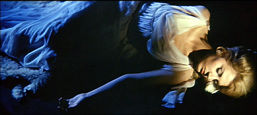
Thanks to his extensive experience as a cinematographer, Bava brings a fully formed sensibility to his first color film and lays out the visual motifs which would latter reach full bloom in such classics as Planet of the Vampires. Using a minimal budget and limited sets to his advantage, Bava turns his soundstages and miniatures into delirious whirlpools of color and texture, pitting his actors against a seemingly endless array of imaginative obstacles. The heroes' climb over bubbling lava, for example, is an expertly rendered example of a special effects set piece created from the barest elements posssible, while the forest and tomb sequences bring the established environments of Black Sunday into a new context, splashed with unnatural waves of red and blue light. The actors can't help but pale against such settings, but Park makes for one of the more interesting and intelligent Italian muscelemen, while Lee as usual makes for an imposing figure despite his relatively limited screentime. A subplot involving Theseus' infatuation with Persephone, the mythical daughter of Pluto, is also imaginatively handled and fits in nicely with the doom-laden romances of Bava's subsequent work.
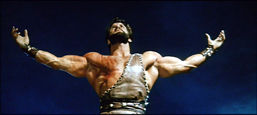
Most widely seen in a laughably dubbed U.S. version from Woolner Brothers which omits and reshuffles several chunks of footage, Hercules in the Haunted World finds much of its dignity restored with this long overdue, definitive treatment of the original, undoctored edition. Boasted the European English language title of Hercules at the Center of the Earth on the actual print, this transfer contains the original opening title sequence (against a stony tomb) and thankfully preserves both the dopey English dub track and the original Italian version which, while less faithful to the actors' actual lip movements, adds some desperately needed gravity to the potentially silly storyline. The optional English subtitles translate the Italian dialogue directly, which makes for a fascinating comparison against the more simplistic English dub.

Italian horror legend Mario Bava's oddest murder mystery, Five Dolls for an August Moon, is a film more often discussed than actually seen.
Never released theatrically in America (unlike its bloodsoaked counterpart, Twitch of the Death Nerve) and often condemned by no less than the director himself, the film has gained back some critical ground in recent years due to its relentless parade of eye candy and easygoing, loungy atmosphere. This is more of a tasty little bon bon for seasoned Eurofanatics than a suitable entry into Bava's candy colored cinematic fairy tales, so don't necessarily expect to fall in love with it on first viewing... though many have, and with good reason.
The circuitous plotline follows a group of people isolated at an ultra-modern beach house on an island, where the well-to-do guests revel in jazzy, twisted party games when they're not too busy trying to wrench a secret new chemical formula from its inventor, Gerry Farrell (William Berger). Though everyone is ostensibly paired off with a partner, flirting and infidelity become the order of the day until someone decides to resort to murder... and one by one, the guests' bodies wind up stashed in plastic wrapping and hung in the meat freezer. As the body count rises, tensions and distrust lead to fistfights, suicides, and an ironic final twist.
lashed to a tree and transfixed with a knife, each body becomes a mounting black joke as the soundtrack pules with Piero Umiliani's delicious, feverish beat score. Though each actor is basically cast as a familiar "type" (the scheming wife, the snotty businessman, the swarthy gigolo), everyone looks terrific and seems to be having a good time. Chief among these is frequent Sergio Martion giallo muse Edwige Fenech, who steals the opening party sequence by dancing with wild abandon, slurping down cocktails, and generally kicking off the proceedings with an air of wicked good humor. Though his heart was supposedly not in the project, Bava nevertheless invests the Ten Little Indians style narrative with some terrific flourishes, such as the langorous shots of lovers passing cigarettes with their toes in bed and the oft-admired, astounding montage of a dish of marbles scattering down a flight of stairs and splashing into a victim's tub.
The only widely circulated English edition of Five Dolls came on British VHS courtesy of Redemption, but the Image DVD proves to be worth the wait. Vibrantly colorful and well framed at 1.85:1, the transfer has been lifted from a nice, almost immaculate print and features both the English-dubbed soundtrack (more or less in sync with the multinational actors but rather tinny sounding) and the more poetic Italian dialogue track, complete with newly translated, optional English subtitles. Furthermore, the print contains an extended end credits sequence omitted from all previous video transfers along with the familiar playout music following the end credits. Also, Italian soundtrack fans should pay close attention to the menu screens... Obviously supplements for this barely distributed film are limited, but the disc does come with informative liner notes from Tim Lucas filled with the usual amusing anecodtes, as well as other Bava trailers and filmographies for Bava, Fenech, and Umiliani.
This oppressive and visually overwhelming exercise in the conjuring of atmosphere allowed Mario Bava to crank the gothic stylistic tendencies of Black Sunday into
overdrive, finally permitting him to churn out scene after scene of hallucinatory intensity with only the barest threads of a plot to hold it all together. The avenging demonic forces of his past films have been distilled here into the single, chilling image of a ghostly young girl, rolling a sinister pale ball down hallways and street corners as she drives those around her to certain death. Rarely has a more haunting or unforgettable specter graced the horror cinema, and even had he never made another film after this, Bava would have already proven himself as a master filmmaker.
heart, a local superstition carried out by the local witch, Ruth (Fabienne Dali), who uses home remedies to aid her townspeople. Eswai goes to the Villa Graps where the reclusive Baroness (Gianna Vivaldi) proves to be less than forthcoming. Apparently the villagers' callous irresponsibility led to the death of her young daughter, Melissa, who now haunts the town at night and strikes down those who even dare to mention her name...
the score once again (supplemented by some Roman Vlad passages), including a few quotes from his previous Blood and Black Lace score, some apparently augmented by the U.S. distributor. 
The most overtly sexualof Mario Bava's gothic masterpieces, The Whip and the Body was rarelyseen in its original form thanks to the threatening blend of S&M-themedromanticism and morbid horror. Thanks to home video, slightly differingversions began to surface, ranging from the
originalEuropean cut on Japanese laserdisc to an essentially complete U.S. edition(under the title What!) with an alternate opening credits sequence.Even given this exposure, however, the film remains more widely discussedthan actually seen, but admirers of early Bava gems like Black Sundayand Black Sabbath will find a similar treat for the senses here.
eveningKurt is stabbed to death. Though Kurt's body is entombed, Nevenka beginsto experience spectral encounters in which he enters her bedroom and whipsher savagely. Strange deaths continue, and as the family deteriorates,the sadistic spirit of Kurt seems to hold sway over everyone involved.
After years of scratchy, faded videotapes, VCI's DVD of The Whip andthe Body is nothing less than a revelation. The source material isin remarkable condition, particularly considering the rarity of the filmitself, and thankfully it has been derived from a European source withthe original opening titles (on red satin, natch). The U.S. credits arealso included as a supplement. The letterboxing looks perfect, while theeerie chroma schemes come through even better than the Japanese version.Though all versions of the film were dubbed, the English dialogue trackis just as acceptable as the Italian one, with optional English subtitlestranslated from the Italian also included for comparison. Tim Lucas returnsfor another multi-layered, finely arranged commentary track. Includingmore humorous asides than usual, he offers a breezy tour through Bava'sgallery of morbid imagery with a sure hand, pointing out trivia about eventhe smallest background players and discussing a multitude of technicalaspects. The DVD also contains a French trailer (under the title LeCorps et le Fuet, sans subtitles)along with trailers for Blood and Black Lace and, most surprisingly,Bava's magnificent Planet of the Vampires. A gallery of photos andposters rounds out this most unexpected and gratifying special edition. 
After more attempts than onecould ever want to count, Mario Bava'sseminal body count giallo, Blood and Black Lace, has finallybeen released in a worthy
videoedition for English speaking viewers. A stripped down, delirious tour ofa candy-colored murder zone, this was really the first film to merge thefashion world with ritualistic murders, and none of its imitators havemanaged to capture the same level of intensity. Originally released asSei Donne per l'Assassino (or Six Women for the Murderer),Bava's film encountered censorship problems around the world and has beenvirtually impossible to see in its complete form until now.
throughseveral other hands, all of them swiftly cut down by the ruthless killer,before a double twist ending exposes the nasty truth.
The complete history of Blood and Black Lace has become an exercise in frustration for manyhorror fans. The original U.S. prints and first VHS video (from Media HomeEntertainment) were trimmed, with the opening murder of Isabella lackinga few brutal seconds of her tree bashing. More significantly, the bathtubmurder near the climax of the film was missing several shots of ClaudeDantes in a see-through bra, floating dead in the tub as blood begins toseep from her wrists. The Japanese laserdisc was likewise edited but atleast letterboxed (a little overzealously at 1.85:1), fairly colorful,and containing the beautiful original European opening titles shot by Bavahimself (under the Six Women for a Murderer title). Sinister Cinemareleased a semi-letterboxed edition on video a few years ago, containingthe full bathtub murder but taken from a touch-and-go print littered withscratches and speckles. Then came the Roan edition on laserdisc, whichincluded the amusing opening U.S. credits (from Filmation) in very poorshape, with warbly sound, but restored the first murder. Unfortunatelythe bathtub murder was still cut, causing a severe jump cut as the killer'smask is removed, not to mention a gash in the music; considering that thisis arguably the most famous scene in the film (and immortalized uncut inthe opening credits of Pedro Almodovar's Matador), this oversightwas galling.