Color, 2000, 97 mins. / Written and Directed by Wong Kar-wai / Starring Tony Leung, Maggie Cheung, Ping Lam Siu / Music by Mike Galasso / Cinematography by Christopher Doyle and Mark Lee Ping-bin
Criterion (MSRP $39.98) / Letterboxed (1.85:1) (16:9) / Dolby Digital 5.0
In 1962 Hong Kong, newspaper man Chow (Tony Leung) and his wife move into an apartment where another couple by chance is also settling in down the hall. Left alone to unpack due to his wife's perpetual absence, Chow strikes up a silent rapport with the other couple's female half, Li-zhen (Maggie Cheung), a secretary whose husband also leaves her constantly in solitude. They pass each other on the stairs and in the hall, but significant clues lead to an encounter in a noodle shop where they realizes their respective spouses are having an affair. The tentative friendship which blossoms between them, indicating a potential for passion which may never erupt.
The succulent, dreamy air of In the Mood for Love would make it a memorable film on its own, but the perfectly timed physical and emotional steps performed by the two leads elevate to the status of a classic. The marriage of camerawork, color, and thespian nuance create a hermetic world in which love and sex rarely collide. Furthermore, the suppressed and ultimately doomed battle between the heart and social morality recalls Edith Wharton, though Kar-wai's approach far surpasses the similarly themed Ethan Frome and The Age of Innocence, the latter of which was filmed in a visually lush but ultimately botched attempt by Martin Scorsese. Here the
The widely imported Mei Ah DVD of In the Mood for Love from Hong Kong hit U.S. shores well before its theatrical release through USA, though its flawed non-anamorphic presentation and erratic English subtitles (which don't translate any of the written onscreen intertitles or text) made it only a passable temporary option. In the U.K., Tartan issued a single disc version (£18.59) with minimal extras, followed several months later by a two disc set (£21.59) loaded with supplemental features. These bonuses have been carried over in the U.S. to the Criterion two-disc set, which boasts the trump card of a new, fully restored anamorphic transfer that outclasses its predecessors by a wide margin. The print looks flawless and richly detailed, with colors which appear luminous without becoming oversaturated. English subtitles are optional, and the audio options include a 5.0 mix (which sounds nice and spacious) and the theatrical 2.0 mix. (For some reason the Mei Ah disc contained a 5.1 track that never really used the subwoofer and sounds much less textured than the Criteiron one.) Extras include deleted scenes (including an alternate ending and a fascinating '70s sequence jettisoned from the final assembly), a 22-minute interview reel with Wong Kar-wai, a terrific 53-minute documentary involving the director's painstaking creative process (which reportedly drove the actors nearly mad), an assortment of teasers, TV spots, and trailers from Hong Kong, France, and the U.S. (the last scored with Bryan Ferry's rendition of the title tune), a 15-minute press conference interview with Kar-wai, cast and crew bios, a delectable gallery of preliminary poster art and the final promotional artwork from around the world (with the Japanese one a particular standout),the 18-minute international press kit reel, a text essay about the director's work entitled "The Searcher," a written study of 1960s Hong Kong by Gina Marchetti, a 43-minute Tokyo International Film Festival conference with Cheung and Leung from 2000, a study of the source music and score used in the film, and finally, "Hua yang ne nian hau," a lyrical montage of archival nitrate material from Hong Kong cinema assembled by Kar-wai. Easily one of Criterion's finest forays into a current film already being acknowledged by many as a classic, this elegant set provides hours of engrossing entertainment and should help bolster the already stellar reputation of this remarkable film.
Color, 1994, 100 mins. Written and Directed by Wong Kar-wai
Starring Brigitte Lin, Leslie Cheung, Maggie Cheung, Tony Leung Chiu Wai, Jacky Cheung, Tony Leung Ka Fai, Li Bai / Music by Frankie Chan / Produced by Sung-lin Tsai / Cinematography by Christopher Doyle
Format: DVD - Mei Ah (approx. $35)
Letterboxed (1.85:1) / Dolby Digital Mono
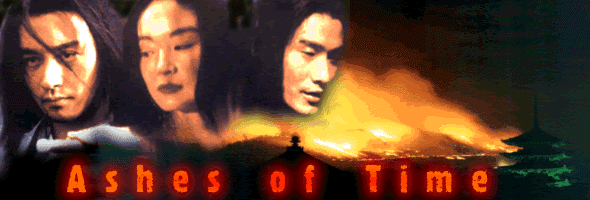
Most viewers will have difficulty piecing together any sort of linear narrative for at least the first half of the film, but the familiar character tropes should be enough to at least convey the basic concepts: Ou-yan Feng (Leslie Cheung, of course), a wandering, alienated swordsman; Yin and Yang (the lovely Brigitte Lin), who may or may not be the same person and the object of our hero's vengeful quest; and a blind swordsman (Tony Leung) who uses his other heightened senses to improve his physical skills. Obvious similarities to the films of Sergio Leone abound, of course, ranging from the music to the wide open vistas and jarring close ups. However, a modern sensibility consistently infiltrates the proceedings: the jagged, often dreamlike storytelling techniques; the jaded, unsatisfied attitudes of the characters; and the lyrical sensuality of Christopher Doyle's breathtaking cinematography, which can make the simple image like a woman's leg straddling a rock over a covered stream into an aesthetic creation of exquisite beauty. The seemingly random introduction of fantastic elements, such as an elixir which brings on memory loss and causes numerous subsequent plot complications, are integrated so naturally into the film's fabric that the viewer is never even given a moment to question them. An unusually sensitive and sweeping score by Frankie Chan (thankfully available on CD) fills in the rest of the emotional holes, making this an experience which gains in significance and richness long after the end credits have rolled.
Loosely based upon Louis Cha's classic Chinese novel, The Eagle Shooting Heroes (given a lighter cinematic treatment under its original title one year earlier), Ashes of Time never received as much acclaim or recognition as its director's other films in the U.S., remaining largely ignored outside the festival and cult film circuits. This situation has not been helped by the most widely available U.S. DVD edition from World Video and Supply, a technical and overmatted nightmare that makes the film well nigh unwatchable. Fortunately, the Mei Ah DVD, available from Chinese video shops and online retailers, provides a much closer replication of the theatrical experience. Some distracting print damage remains evident throughout, a sad commentary on the preservation of even the most recent films, but at least the image is framed correctly and features legible English subtitles (burned in, alas). Sound quality is not perfect but acceptable, with the dialogue, music, and sound effects delivered quite well for mono. If ever a film cried out for a 5.1 remix, this would be it; in the meantime, this will just have to do. No extras, but considering this is the only passable way to see the film outside of a theater, viewers will have little room to quibble.
Originally planned under the title Summer in Beijing, this evocative drama continues the string of Wong Kar-wai masterpieces named after pop standards (e.g., Happy Together). Though the director already enjoyed a solid arthouse and cult reputation, In the Mood for Love garnered his widest mainstream acclaim thanks to its dizzying atmosphere and the star power of its two leads, a period dressed pairing made in movie heaven.
Wharton principle is carried through perfectly thanks to the film's understatement and deliberately hypnotic pace, which may be offputting to some viewers. As with the director's previous efforts, the refusal to conform to standards of genre and plotting results in some fascinating new experimental effects. He leaves open gaps in his story for viewers to fill in their own details, an approach which pays off here with breathtaking results. The haunting coda in particular has a peculiar resonance which lingers in the air far longer than the smoke from the characters' omnipresent cigarettes.

That rarest of beasts, a delicate sword-swinging action film, Ashes of Time revolutionizes the period heroic format in much the same way director Wong Kar-wai created a new vocabulary for '90s urban action and domestic drama (Chungking Express, Happy Together, Fallen Angels, etc.).
